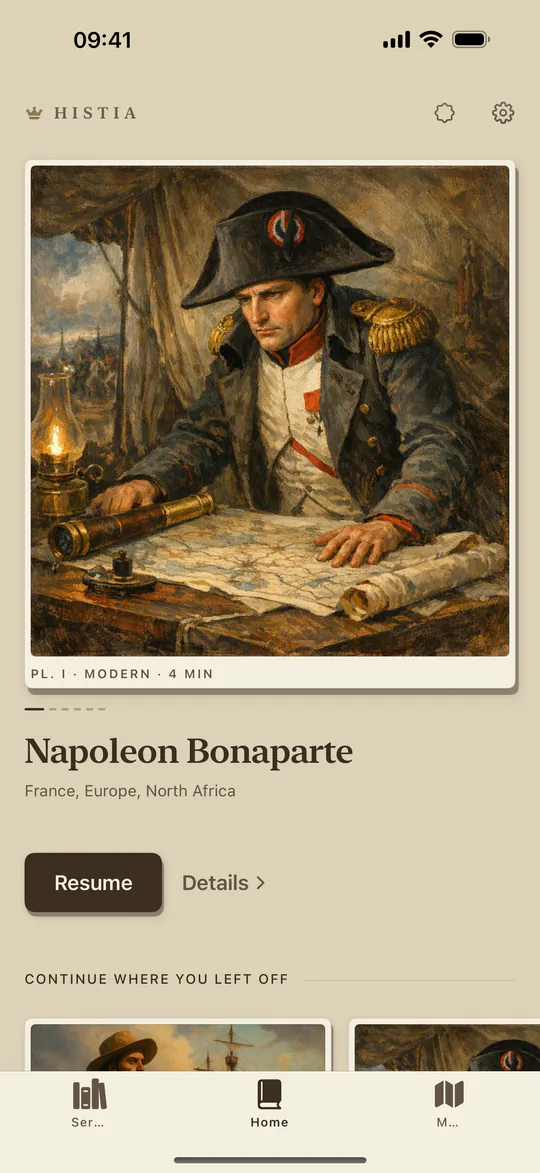
France and Europe · 1769–1821
Napoleon Bonaparte: 16 facts and 4 myths
Napoleon Bonaparte (1769–1821) rose from minor Corsican nobility to general at 24, First Consul at 30 and emperor at 35, crowning himself at Notre-Dame in 1804. He reshaped French law with the Civil Code, founded the Banque de France and the Légion d'honneur, sold Louisiana to the United States, and lost most of his army in Russia in 1812. Defeated at Waterloo in 1815, he died in exile on Saint Helena in 1821. And he was not short.
16 facts about Napoleon
- He was born in Corsica in 1769, a year after France acquired the island. Napoleone di Buonaparte was born in Ajaccio on 15 August 1769 into a family of minor Corsican nobility, and trained at the royal military school of Brienne in mainland France.
- French was his second language. He grew up speaking Corsican, close to what we would now call Italian, took an intensive French course in 1778, and kept his accent for the rest of his life.
- He was a general at 24. After commanding the artillery that drove the British and Spanish out of Toulon in 1793, he was promoted to brigadier general at 24.
- He made his name in Paris with grapeshot. In early October 1795 (13 Vendémiaire) his guns fired grapeshot into a royalist crowd marching on the government, which made him the Directory's indispensable general.
- He took scientists to war. The 1798 invasion of Egypt carried around 150 civilian scholars, the savants, whose work became the multi-volume Description de l'Égypte.
- His expedition found the Rosetta Stone, and Britain kept it. French soldiers uncovered it near Rosetta in July 1799; the British took it after defeating the French in Egypt in 1801, and it has been in the British Museum since 1802.
- He took power in a bloodless coup. On 9–10 November 1799 (18 Brumaire) he overthrew the Directory and became First Consul, ruler of France in all but name.
- He founded France's central bank. The Banque de France was created on 18 January 1800 at the First Consul's instigation, and it is still the country's central bank.
- The Légion d'honneur was his idea. Created by the law of 19 May 1802, it rewarded civilian service as well as military courage, and it remains France's highest order.
- He sold the United States more land than it asked for. American envoys came to Paris to buy New Orleans; in 1803 Napoleon sold them the whole Louisiana territory for $15 million.
- His Civil Code had 2,281 articles. Promulgated on 21 March 1804, the Code civil set out a single law on persons and property for all of France and became a model for civil law far beyond it.
- He crowned himself. At Notre-Dame on 2 December 1804, Pope Pius VII was present for the consecration, but Napoleon placed the imperial crown on his own head.
- Austerlitz fell on the anniversary of his coronation. On 2 December 1805 he defeated the Austrian and Russian armies, a battle widely regarded as his greatest victory.
- Russia destroyed his army. He invaded in June 1812 with somewhere between 440,000 and 615,000 men, depending on how reinforcements are counted; about 60,000 came back across the Niemen.
- He escaped from his first exile. Sent to Elba in 1814, he landed in southern France on 1 March 1815 with about 1,000 soldiers and ruled again for the Hundred Days, until Waterloo on 18 June.
- He died on Saint Helena and came home 19 years later. He died on 5 May 1821, aged 51. His remains travelled more than 7,200 km to Paris and were laid in Les Invalides in December 1840.
4 myths about Napoleon
- Myth: He was short. What the evidence says: Recorded at 5 feet 2 inches in French units, where the French inch was longer than the English one, he stood about 5 ft 6 or 7 in (1.68–1.70 m), average or a little above for his time. British cartoons of "Little Boney" did the rest, and "le petit caporal" was a term of affection from his soldiers.
- Myth: He said "Not tonight, Josephine." What the evidence says: No printed record of the phrase exists from his lifetime, in any language. It appears in English about a century after his death.
- Myth: He was poisoned with arsenic. What the evidence says: The 1821 autopsy found stomach cancer, and a 2007 review of the autopsy and his doctors' notes concluded that advanced gastric cancer was the most likely cause of death. The arsenic theory, based on hair samples, is now a minority view.
- Myth: His soldiers shot the nose off the Sphinx. What the evidence says: The Danish explorer Frederic Louis Norden drew the Sphinx without its nose decades before Napoleon was born. The medieval historian al-Maqrizi blamed a 14th-century iconoclast.
Test yourself: three questions from the app
These come from the quiz that follows Histia's Napoleon story. Tap an answer to see whether you are right and why.
-
Austerlitz, in 1805, is often called Napoleon's masterpiece. Whom did he defeat?
Show the answer
D. The combined Russian and Austrian armies. Known as the Battle of the Three Emperors. He deliberately weakened his own right flank to invite the attack that destroyed the allied centre.
-
Napoleon was exiled twice. Which island came first?
Show the answer
A. Elba. He escaped Elba after ten months and ruled again for the Hundred Days. After Waterloo the allies chose Saint Helena — in the middle of the South Atlantic.
-
Who commanded the allied army that defeated Napoleon at Waterloo?
Show the answer
D. The Duke of Wellington, with Blücher's Prussians arriving late in the day. Nelson had died at Trafalgar ten years earlier; Ney was one of Napoleon's own marshals. Wellington called it 'the nearest-run thing you ever saw'.
Frequently asked questions
How tall was Napoleon really?
About 5 feet 6 or 7 inches (1.68–1.70 m). His recorded height of 5 feet 2 inches was in French units, which were longer than English ones, and the conversion error was helped along by British cartoons.
How did Napoleon die?
He died on Saint Helena on 5 May 1821, aged 51. The autopsy found stomach cancer, and a 2007 review of the medical evidence concluded that advanced gastric cancer was the most likely cause; the arsenic theory is a minority view.
Why was Napoleon exiled twice?
After his first abdication in 1814 he was sent to Elba, close enough to escape, which he did in February 1815. After Waterloo the allies chose Saint Helena, in the middle of the South Atlantic, so he could not return.
Sources & further reading
Every fact and date on this page was checked against the sources below on October 13, 2026. Each link was opened and is live:
- World History Encyclopedia — Napoleon Bonaparte
- Fondation Napoléon — What was Napoleon's mother tongue?
- Fondation Napoléon — The promulgation of the Civil Code, 21 March 1804
- Fondation Napoléon — The coronation of Napoleon I
- Fondation Napoléon — The Russian campaign of 1812
- Fondation Napoléon — The return of Napoleon's remains to Paris, 1840
- U.S. Office of the Historian — The Louisiana Purchase, 1803
- Banque de France — The founding of the Banque de France
- Linda Hall Library — Napoleon and the scientific expedition to Egypt
- History (UK) — The Rosetta Stone is discovered
- National Geographic — Napoleon's height and the 'Napoleon complex'
- National Geographic — Napoleon's cause of death
- The Phrase Finder — "Not tonight, Josephine"
- History Hit — Who broke the Great Sphinx's nose?
Spotted an error? Tell us — corrections are logged and the update date above is revised.
Rather listen?
Hear “Napoleon Bonaparte” as a five-minute story.
It is a narrated story in Histia, the free history app for iPhone and iPad, followed by an eight-question quiz.
- Listen, read, or watch in cinematic mode
- Read along with the narration
- A map of history from 3000 BCE to 2025

Free to download · Optional in-app purchases · iOS 18+