Eurasia · c. 130 BCE – 1453 CE
What Was the Silk Road?
The Silk Road was not a road — it was a shifting network of overland and maritime routes linking China to Central Asia, India, Persia, and the Mediterranean for roughly 1,500 years, conventionally from the Han dynasty's westward missions (c. 130 BCE) to the Ottoman capture of Constantinople (1453). Silk gave it its 19th-century name, but its real cargo was everything: horses, glass, paper, spices, gold — and non-goods that mattered more, including Buddhism entering China, technologies moving west, and, in the 1340s, most likely the plague. Almost no one traveled it end to end: goods moved in relays, changing hands at oasis cities that grew rich on the passage.
Key facts
- The name is modern: German geographer Ferdinand von Richthofen coined "Seidenstraße" ("silk road") in 1877. No merchant on the routes ever called it that.
- The conventional starting point is the mission of Zhang Qian, sent west by Han emperor Wudi around 138 BCE; his reports opened Chinese eyes to Central Asia — and to the "heavenly horses" of Ferghana that the Han army wanted badly enough to go to war for.
- Silk reached Rome through so many intermediaries that Rome and Han China never dealt directly — Romans called the Chinese Seres, "the silk people," and moralists like Seneca fretted that the transparent fabric would corrupt Roman virtue.
- China guarded sericulture for centuries; by the account of the historian Procopius, the secret finally broke when monks smuggled silkworm eggs to Byzantium around 552 CE — reputedly inside hollow walking staffs.
- The routes carried religions as reliably as goods: Buddhism traveled from India into China along them in the first centuries CE — the cave-temple library at Dunhuang preserved tens of thousands of manuscripts — followed by Nestorian Christianity, Manichaeism, and Islam.
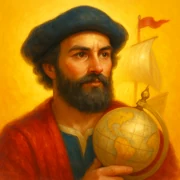
- Traffic surged one last time under the Mongol Empire's enforced peace (the era of Marco Polo, 1271–95) — and the same connectivity most likely carried the Black Death westward in the 1340s, killing perhaps a third of Europe.
A network, not a highway
The map that matters is less a line than a mesh. Overland corridors skirted the Taklamakan desert's northern and southern rims, threaded the Pamirs, crossed Persia to the Levant; maritime spurs ran from Chinese ports through Southeast Asia to India, the Gulf, and the Red Sea. Few traders crossed more than a segment: a bale of silk might change hands a dozen times — Chinese, Sogdian, Persian, Arab, Greek — before reaching a Mediterranean buyer, its price multiplying at each relay. The true operators of the system were middleman peoples, above all the Sogdians of Samarkand and Bukhara, whose language became the network's lingua franca.
The network's nodes — Kashgar, Khotan, Turfan, Dunhuang, Merv — were oasis cities that turned geography into wealth: water, fodder, protection, and markets, sold to every caravan. Their cosmopolitanism was the network's signature; a single Turfan document might involve Buddhists, Zoroastrians, and Christians witnessing one contract.
What actually traveled
Silk headed west from the start — light, valuable, durable, the perfect long-haul cargo — but the reverse and lateral flows shaped history at least as much. China imported horses (the Ferghana breed that its cavalry needed against the steppe), glassware, silver, wool, and cotton. Westward went peaches and paper — the technology that, once it crossed into the Islamic world in the 8th century (by tradition after the Battle of Talas in 751, a story historians treat with caution), became the substrate of a scientific golden age and, eventually, of European printing.
Ideas moved with the freight. Buddhist monks and merchants carried texts and images from India along the eastern corridors; the art of Gandhara — Greek technique, Buddhist subject — is the network's visual fingerprint. Later centuries added Nestorian Christianity and Islam. And microbes traveled too: the Justinianic plague of the 540s and the Black Death of the 1340s both most plausibly rode the trade routes, a reminder that connectivity has never been free.
Peak, decline, and afterlife
The network's last great age was Mongol. By unifying the steppe under one enforced peace — the Pax Mongolica — the 13th-century empire made it briefly possible to travel from the Black Sea to Beijing under a single protection, which is exactly what the Polos did. Their account, however embroidered, fixed Cathay in the European imagination and, famously, in the margins of the Genoese charts Columbus read.
Decline came from economics, not a single event. Ming China turned inward; the Mongol peace fragmented; and above all, ocean shipping matured — a Portuguese carrack around the Cape carried more than a thousand camels, with fewer tolls. The Ottoman capture of Constantinople in 1453 makes a convenient bookend because it pushed Europeans harder toward the sea routes that made the overland relays obsolete. The name, though, refused to die: coined by a geographer in 1877, listed by UNESCO in 2014 along a 5,000-kilometre corridor, and borrowed today for everything from pipelines to policy slogans — a 2,000-year-old brand for the idea that trade stitches worlds together.
Frequently asked questions
Was the Silk Road a single road?
No. It was a network of shifting overland corridors and maritime routes across Eurasia, used for roughly 1,500 years. Goods moved in relays between middlemen — a load of silk might change hands a dozen times between China and the Mediterranean — and almost no individual trader traveled the whole way.
What traveled on the Silk Road besides silk?
Westward: paper, peaches, and eventually gunpowder and the compass; eastward: horses, glass, silver, wool, and cotton. Religions moved with the goods — Buddhism into China above all — along with art styles, technologies, and diseases, including, most historians think, the Black Death of the 1340s.
Why did the Silk Road decline?
Mainly because ocean routes outcompeted it: by the 15th–16th centuries a single ship could carry more cargo than a large caravan, with fewer intermediaries and tolls. The fragmentation of the Mongol peace and Ming China's inward turn weakened the overland relays; the Ottoman capture of Constantinople in 1453 is the conventional bookend, pushing Europe decisively toward the sea.
Sources & further reading
This article was written from the published record. Every link below was checked and is live:
- Silk Road Seattle, University of Washington — Silk Road texts and resources
- UNESCO World Heritage — Silk Roads: the Chang'an–Tianshan Corridor
- Wikipedia — Silk Road
- Wikipedia — Zhang Qian
Spotted an error? Tell us — corrections are logged and the update date above is revised.
Rather listen?
Hear “Opening the Silk Road” as a five-minute story.
It is a narrated story in Histia, the free history app for iPhone and iPad.
- Listen, read, or watch in cinematic mode
- A quick quiz to lock it in
- A map of history from 3000 BCE to 2025

Free to download · Optional in-app purchases · iOS 18+