Renaissance Europe · c. 1440–1455
How Did the Printing Press Change the World?
Johannes Gutenberg's movable-type printing press, developed in Mainz, Germany around 1440–1450, let books be mass-produced for the first time in history, collapsing the cost of a book by roughly 95% within decades. That triggered an information explosion: an estimated 20 million books were printed in Europe by 1500 alone, fueling the spread of literacy, the Protestant Reformation, and the Scientific Revolution — while Gutenberg himself, ruined by legal disputes, never profited from his own invention.
Key facts
- Before Gutenberg, a single hand-copied Bible could take a scribe months to over a year to complete; his press could produce that many pages in a single day.
- His workshop's masterpiece, the Gutenberg Bible (c. 1455), printed roughly 180 copies — about 49 survive today, and a complete copy is considered one of the most valuable printed objects on Earth.
- Gutenberg lost his own printing business in a lawsuit to his financial backer, Johann Fust, in 1455 — right around the time his Bible was completed — and died without significant profit from his invention.
- Within 50 years of Gutenberg's press, printing had spread to over 250 European cities, and estimates suggest as many as 20 million books had been printed — more than all European scribes combined had produced in the previous 1,000 years.
- Martin Luther's 95 Theses (1517) spread across Germany in printed form within about two weeks and across Europe within two months — a speed of ideological spread previously unimaginable, powering the Reformation.
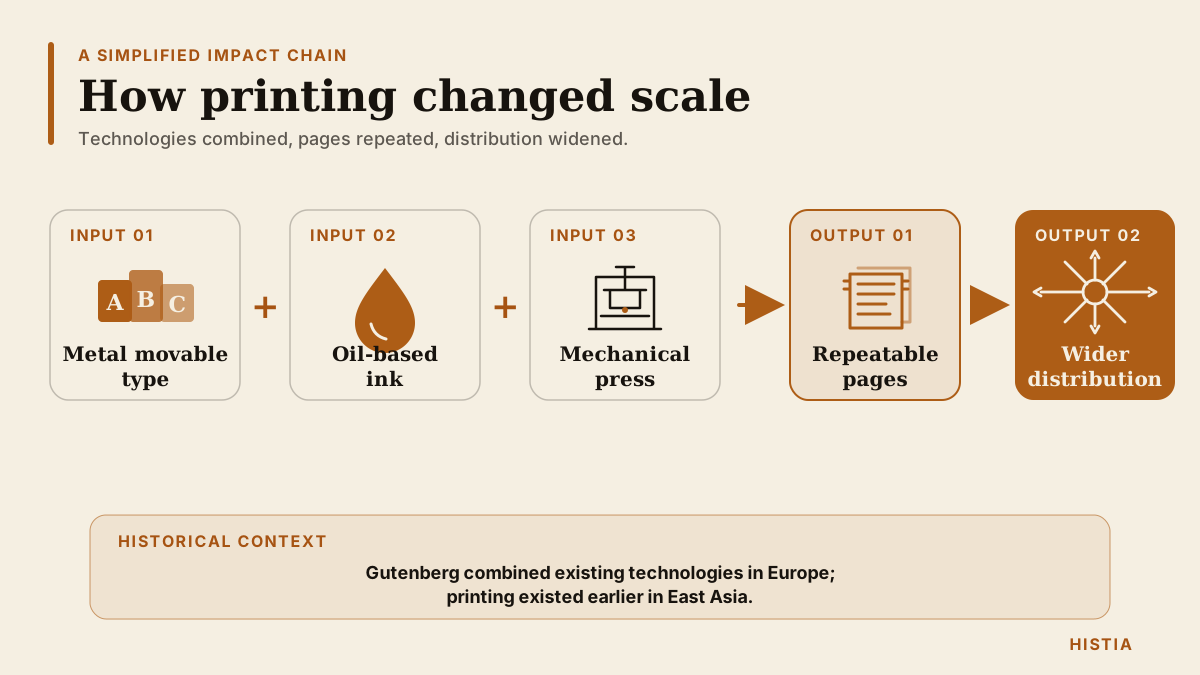
- Gutenberg adapted existing technology in a novel combination — oil-based ink, a modified wine/olive-press mechanism, and durable metal movable type cast from a lead alloy — rather than inventing printing itself, which had existed with woodblocks in East Asia for centuries.
The bottleneck the press broke
For most of human history, information moved only as fast as it could be copied by hand. Before the mid-1400s, European books were reproduced by scribes, usually monks, working letter by letter — a single Bible could take a skilled copyist the better part of a year, meaning books were catastrophically expensive and rare, effectively confined to churches, monasteries, universities, and the wealthy. Literacy had little practical use for most people because there was almost nothing affordable to read.
Johannes Gutenberg, a goldsmith by trade working in Mainz and Strasbourg, spent years in secretive, heavily indebted experimentation trying to mechanize the process. His breakthrough wasn't a single idea but an engineering system: individual, reusable metal letters cast precisely and identically from a lead-tin-antimony alloy, arranged into pages, coated with a specially formulated oil-based ink (existing water-based inks wouldn't adhere to metal type), and pressed onto paper using a mechanism adapted from wine and olive presses. Around 1440-1450, the system worked.
The Bible that bankrupted its inventor
Gutenberg's crowning achievement was a 42-line Latin Bible, produced around 1455 in an edition of roughly 180 copies — a staggering number by the standards of hand-copied books, and a fraction of what his press would soon make routine. The irony is bitter: to fund the operation, Gutenberg had borrowed heavily from a wealthy investor, Johann Fust. As the Bible neared completion — his life's work, arguably history's most consequential invention, nearly finished — Fust sued him for repayment, and a court awarded Fust the printing equipment, the type, and effectively the business itself.
Gutenberg, the inventor of the technology that would define the next four centuries of human knowledge, died in 1468 in relative poverty, credited by few of his contemporaries and profiting from almost none of what followed. Fust's operation, run afterward with Gutenberg's former assistant Peter Schöffer, became one of early Europe's most successful print shops.
From dozens of books to twenty million
What happened next moved faster than anyone in 1450 could have anticipated. Printing technology and printers themselves spread outward from Mainz along trade routes; by 1470 presses operated in Rome, Venice, and Paris; by 1500, over 250 European cities had printing operations, and historians estimate somewhere around 20 million books had been printed — likely exceeding the total output of European scribal copying across the previous millennium. Prices collapsed correspondingly; a book that cost a skilled craftsman months of wages in 1450 might cost a fraction of that by 1500.
The consequences cascaded through every domain of European life. Literacy, no longer bottlenecked by book scarcity, spread beyond clergy and nobility into merchant and artisan classes. Standardized printed texts let scholars across different cities cite the identical page for the first time, accelerating scientific and scholarly cross-referencing — a foundational condition for the Scientific Revolution that followed. And ideas themselves moved at unprecedented speed and volume.
The Reformation the press made possible
No event illustrates the press's power better than the Protestant Reformation. When the monk Martin Luther nailed (or, per some historians, more likely mailed) his 95 Theses criticizing Church practices to the Wittenberg church door in October 1517, he was doing what dissenting theologians had done for centuries — a local academic challenge, expected to circulate among a handful of scholars. Instead, printers in Wittenberg, then Leipzig, Nuremberg, and Basel copied and redistributed his Theses without his involvement; contemporary accounts describe them spreading across Germany within about two weeks and across Europe within roughly two months — a velocity of ideological transmission that had never existed before in human history.
Luther grasped what had happened faster than most and became history's first mass-media author, publishing pamphlets in German (not scholarly Latin) aimed directly at ordinary readers; some of his works sold in the hundreds of thousands of copies during his lifetime. The Church, which had suppressed heresies for centuries through localized, controllable means — trials, book-burnings, excommunication — found itself facing an idea that had already outrun every mechanism it had for containing one. The press hadn't just spread the Reformation; it had made a Reformation of that speed and scale structurally possible for the first time.
Frequently asked questions
Did Gutenberg invent printing itself?
Not entirely — woodblock printing had existed in China and Korea for centuries before Gutenberg, and Korea had even experimented with metal movable type earlier. Gutenberg's specific innovation was a complete, efficient system for European alphabets: durable, precisely-cast reusable metal type, oil-based ink that adhered to metal, and a reliable mechanical press — combined into a practical, scalable process that transformed European printing specifically.
Did Gutenberg get rich from his invention?
No — one of history's great ironies. His financial backer, Johann Fust, sued him for loan repayment right as his masterwork, the Gutenberg Bible, was nearing completion around 1455, and a court awarded Fust the printing business and equipment. Gutenberg died in 1468 without significant profit from an invention that reshaped the world.
How did the printing press cause the Protestant Reformation?
Martin Luther's 95 Theses, posted in 1517, were copied and distributed by printers across Germany within about two weeks and across Europe within two months — a speed of ideological spread impossible before mass printing. Luther then published pamphlets directly in German for ordinary readers, becoming history's first mass-circulation author and letting reformist ideas outrun the Catholic Church's traditional methods of suppression.
Sources & further reading
This article was written from the published record. Every link below was checked and is live:
- Library of Congress — Gutenberg Bible collection item
- Library of Congress — Gutenberg resource guide
- World History Encyclopedia — Johannes Gutenberg
- Project Gutenberg — Public-domain text archive
- Wikipedia — Johannes Gutenberg
- Wikipedia — Printing press
- Wikipedia — Ninety-five Theses
Spotted an error? Tell us — corrections are logged and the update date above is revised.
Rather listen?
Hear “Gutenberg's printing press” as a five-minute story.
It is a narrated story in Histia, the free history app for iPhone and iPad.
- Listen, read, or watch in cinematic mode
- Read along with the narration
- A map of history from 3000 BCE to 2025

Free to download · Optional in-app purchases · iOS 18+