Free · No sign-up · CC BY 4.0
Interactive world history map: 5,000 years, place by place.
72 turning points pinned where they happened, from the first writing in Uruk to 9/11. Pick a plate, drag through time, or open any pin for the story behind it.
The map
All four plates3200 BCE – 2025
Drag to move · Ctrl or ⌘ + scroll to zoom
How to read it
Each pin marks where a turning point happened. Open one to see what was happening elsewhere at the same time, drag the year to watch history pile up, or start here:
All 72 places, plate by plate
The same pins as a list, in date order. Select a name to find it on the map; 46 of them lead to a sourced explainer.
Plate IAntiquity3200 BCE – 500 CE
- Writing is invented in Sumerc. 3200 BCE · Uruk, Mesopotamia (Iraq)
- Upper and Lower Egypt are unifiedc. 3100 BCE · Memphis, Egypt
- The Great Pyramid of Giza is completedc. 2560 BCE · Giza, EgyptRead
- Hammurabi codifies Babylonian lawc. 1792–1750 BCE · Babylon, Mesopotamia (Iraq)
- The Shang dynasty rules the Yellow Riverc. 1600–1046 BCE · Anyang, China
- Confucius teaches in a fracturing China551–479 BCE · Qufu, state of Lu (China)Read
- Athens invents democracy508 BCE · Athens, Greece
- The Battle of Marathon490 BCE · Marathon, GreeceRead
- Pericles leads Athens at its height461–429 BCE · Acropolis, Athens
- The Peloponnesian War431–404 BCE · Sparta, Greece
- Alexander conquers the Persian Empire336–323 BCE · Babylon, Mesopotamia (Iraq)Read
- Rome and Carthage fight the Punic Wars264–146 BCE · Carthage (Tunisia)
- The Han dynasty opens the Silk Road206 BCE – 220 CE · Chang'an (Xi'an), ChinaRead
- Julius Caesar is assassinated15 March 44 BCE · Curia of Pompey, RomeRead
- Cleopatra dies and Egypt becomes Roman30 BCE · Alexandria, EgyptRead
- The Roman Empire27 BCE – 476 CE · Rome, Italy
- The Western Roman Empire falls4 September 476 CE · Ravenna, ItalyRead
Plate IIMiddle Ages500 CE – 1450
- The Islamic Golden Age8th–13th century · Baghdad (Iraq)
- Charlemagne is crowned emperor25 December 800 · St Peter's Basilica, RomeRead
- Genghis Khan unites the Mongols1206–1227 · Onon River, MongoliaRead
- The Magna Carta is sealed15 June 1215 · Runnymede, EnglandRead
- Mansa Musa rules Malic. 1312–1337 · Timbuktu, MaliRead
- The Hundred Years' War1337–1453 · Castillon, FranceRead
- Henry V wins at Agincourt25 October 1415 · Agincourt, France
- Joan of Arc turns the Hundred Years' War1429–1431 · Orléans, FranceRead
- Gutenberg builds the printing pressc. 1440–1455 · Mainz, GermanyRead
Plate IIIRenaissance1450 – 1700
- The Renaissance14th–17th century · Florence, ItalyRead
- The Age of Exploration15th–17th century · Lisbon, Portugal
- Leonardo da Vinci1452–1519 · Milan, ItalyRead
- Michelangelo1475–1564 · Sistine Chapel, Rome
- Columbus reaches the Americas12 October 1492 · Guanahani, BahamasRead
- Martin Luther publishes the 95 Theses31 October 1517 · Wittenberg, GermanyRead
- The Aztec Empire falls1519–1521 · Tenochtitlan (Mexico City)Read
- Anne Boleyn is executed19 May 1536 · Tower of LondonRead
- Elizabeth I rules England1558–1603 · London, EnglandRead
- Galileo turns a telescope to the sky1564–1642 · Padua, ItalyRead
Plate IVModern era1700 – 2025
- The Enlightenment1650–1800 · Paris, FranceRead
- The Industrial Revolution1760–1840 · Manchester, EnglandRead
- Catherine the Great expands Russia1762–1796 · St Petersburg, RussiaRead
- The American colonies revolt1765–1783 · Boston, MassachusettsRead
- The Declaration of Independence4 July 1776 · Philadelphia, Pennsylvania
- The Bastille is stormed14 July 1789 · Paris, FranceRead
- The Napoleonic Wars1803–1815 · Austerlitz (Moravia, Czechia)
- Napoleon is exiled — twice1814 & 1815 · St Helena, South AtlanticRead
- The Victorian era1837–1901 · Buckingham Palace, London
- The Crimean War1853–1856 · Sevastopol, Crimea
- Florence Nightingale reinvents nursing1820–1910 · Scutari (Üsküdar), Istanbul
- The American Civil War1861–1865 · Fort Sumter, South CarolinaRead
- Abraham Lincoln is assassinated14 April 1865 · Ford's Theatre, Washington, D.C.Read
- Germany is unified18 January 1871 · Hall of Mirrors, Versailles
- Marie Curie discovers polonium and radium1867–1934 · Paris, FranceRead
- Albert Einstein rewrites physics1879–1955 · Bern, SwitzerlandRead
- The First World War1914–1918 · Sarajevo, BosniaRead
- The Russian Revolution1917 · Winter Palace, PetrogradRead
- The interwar years1919–1939 · Versailles, France
- Franklin D. Roosevelt1933–1945 · White House, Washington, D.C.
- The Second World War begins in Europe1 September 1939 · Westerplatte, GdańskRead
- Winston Churchill1874–1965 · Cabinet War Rooms, LondonRead
- D-Day6 June 1944 · Omaha Beach, NormandyRead
- Decolonisation across Africa and Asia1945–1975 · Accra, Ghana
- The Cold War1947–1991 · Checkpoint Charlie, BerlinRead
- The Korean War1950–1953 · Panmunjom, KoreaRead
- Rosa Parks refuses to move1 December 1955 · Montgomery, AlabamaRead
- The Vietnam War1955–1975 · Saigon (Ho Chi Minh City), VietnamRead
- Nelson Mandela's 27 years in prison1962–1990 · Robben Island, South AfricaRead
- Apollo 11 lands on the Moon20 July 1969 · Kennedy Space Center, FloridaRead
- The Digital Age1970s–today · Silicon Valley, California
- The Berlin Wall falls9 November 1989 · Bornholmer Straße, BerlinRead
- The Gulf War1990–1991 · Kuwait City, Kuwait
- The Soviet Union dissolves25–26 December 1991 · The Kremlin, MoscowRead
- Malala Yousafzaiborn 1997 · Mingora, Swat Valley (Pakistan)
- The 9/11 attacks11 September 2001 · World Trade Center, New York
What this map is
Events, not borders
Most history atlases redraw borders year by year. This map does something else: it puts each turning point on the ground where it happened, so you can see that the printing press, the Reformation and Joan of Arc's campaign took place within a few hundred kilometres and a few decades of each other.
Some pins need a choice. A period or a worldwide event gets one representative place: the Cold War stands at Checkpoint Charlie, decolonisation at Accra, the digital age in Silicon Valley. The card under the map says where each pin stands and why. Coordinates mark the named place, not an exact spot.
The map is curated, not complete. An empty region does not mean nothing happened there; it means our 72 entries do not cover it yet. To watch empires grow and shrink, use a border atlas such as GeaCron or Omniatlas; our guide to history map apps compares them.
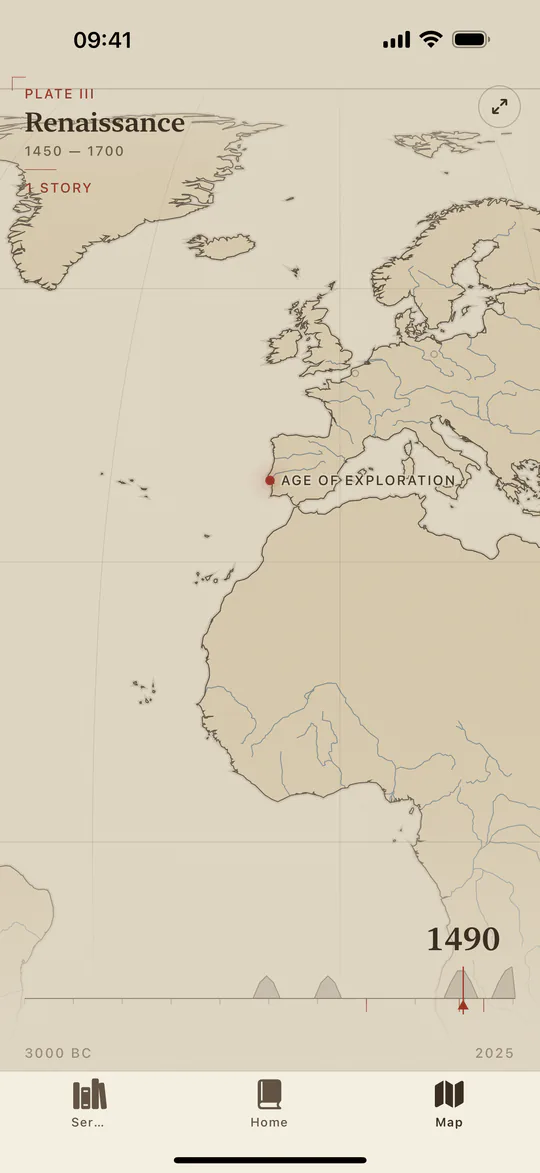
The same plate, in Histia
Tap a pin. Hear the story.
This web map uses the engraved world plate of the Histia app, drawn from the same data in the same projection. In the app, the map runs through four plates from 3000 BCE to 2025, and its markers open five-minute narrated stories you can hear, read or watch, with a written quiz after 27 of them.
Free to download · Optional in-app purchases · iPhone & iPad · iOS 18+
For teachers and writers
Put the map in your lesson, your site or your slides.
The map is licensed CC BY 4.0. Embed it, quote it or share it, as long as you credit Histia.
- No account, no sign-up
- One copy-paste to embed, credit line included
- 46 pins link to an explainer with its sources
- Every pin has its own link, e.g. #the-berlin-wall-falls
- A free printable PDF with every place numbered and keyed
Embed it
Paste this into your page. It shows the map alone, without our menus, and keeps the credit line CC BY asks for.
<iframe src="https://histiaapp.com/guides/interactive-history-map.html?embed=1" width="100%" height="720" style="border:1px solid #ddd;border-radius:12px" loading="lazy" title="Interactive World History Map by Histia"></iframe>
<p style="font-size:14px"><a href="https://histiaapp.com/guides/interactive-history-map.html">Interactive World History Map</a> by Histia, CC BY 4.0</p>
Cite it
- APASouef, W. (2026). Interactive World History Map (3200 BCE – Today). Histia. https://histiaapp.com/guides/interactive-history-map.html
- MLASouef, William. "Interactive World History Map (3200 BCE – Today)." Histia, 14 Oct. 2026, https://histiaapp.com/guides/interactive-history-map.html.
- ChicagoSouef, William. "Interactive World History Map (3200 BCE – Today)." Histia. Last modified October 16, 2026. https://histiaapp.com/guides/interactive-history-map.html.
Frequently asked questions
Is this history map free?
Yes. It needs no account and no download, and it is licensed CC BY 4.0: you can use it in class, embed it on your site or share it, as long as you credit Histia. The embed code and citations are below the map.
What does the map show?
72 turning points of world history, from the invention of writing in Sumer around 3200 BCE to the attacks of 11 September 2001, each pinned where it happened. 46 of them link to a sourced explainer in our History Library. It shows events, people, conflicts and periods, not borders.
Does the map show how borders changed over time?
No. It pins where things happened. To watch borders move year by year, use a border atlas such as GeaCron, Omniatlas, Chronas or OpenHistoricalMap; our guide to history map apps compares them.
Why is a whole period shown at one place?
Periods and worldwide events need a single pin, so we place them where something decisive happened: the Cold War at Checkpoint Charlie in Berlin, the Industrial Revolution at Manchester. Each card says where a pin stands and why.
How do I use the map in class?
Copy the embed code below into your page or learning platform; it shows the map alone with the credit line CC BY asks for. Each pin also has its own link, such as #the-berlin-wall-falls, so you can send students straight to it.
Is there a history map app for iPhone?
Yes. Histia's map through time uses the same engraved plate as this page and opens a five-minute narrated story for the events in its library. For other apps, see the best history map apps.
Sources and method
- Coastlines and rivers: Natural Earth (public domain), simplified and drawn in the Robinson projection, as in the Histia app.
- Events: the entries of our world history timeline, plus three History Library articles; each linked pin leads to an explainer with its own sources.
- Places: each pin marks the place named on its card, chosen by Histia's editors and checked on October 16, 2026. Corrections are welcome through our editorial standards page.