Ptolemaic Egypt · 30 BCE
How did Cleopatra die?
Cleopatra VII died in Alexandria in August 30 BCE, aged about 39. Most surviving ancient writers describe suicide after Octavian captured the city, but they disagree on how she did it. The possibilities they report include the bite of an asp, poisonous ointment, or poison introduced with a small implement. The exact cause is unknown. The snake is a famous ancient tradition, not a forensic fact.
Secure context What we can establish
Cleopatra was the last active ruler of Ptolemaic Egypt. After she and Mark Antony lost to Octavian's forces, Octavian captured Alexandria in 30 BCE. Antony died and Cleopatra died soon afterward. Independent Ptolemaic rule then ended; Caesarion, whom Cleopatra presented as Julius Caesar's son, was killed on Octavian's orders.
The political sequence and approximate date are much firmer than the physical cause of Cleopatra's death. No body securely identified as hers, contemporary autopsy, or eyewitness description of the act survives.
Ancient account Strabo gives two methods
Strabo provides the earliest surviving prose account and was writing relatively close to the events. In Geography 17.1.10, he says Cleopatra secretly killed herself either through the bite of an asp or by applying a poisonous ointment. The uncertainty is therefore not a modern invention: it is already present in an early source.
Ancient account Plutarch reports the famous asp story—and alternatives
Plutarch wrote more than a century after Cleopatra's death. His Life of Antony tells how an asp may have been concealed in a basket of figs, but it also records other possibilities, including poison carried in a hollow implement. He ultimately acknowledges that the true sequence was not known.
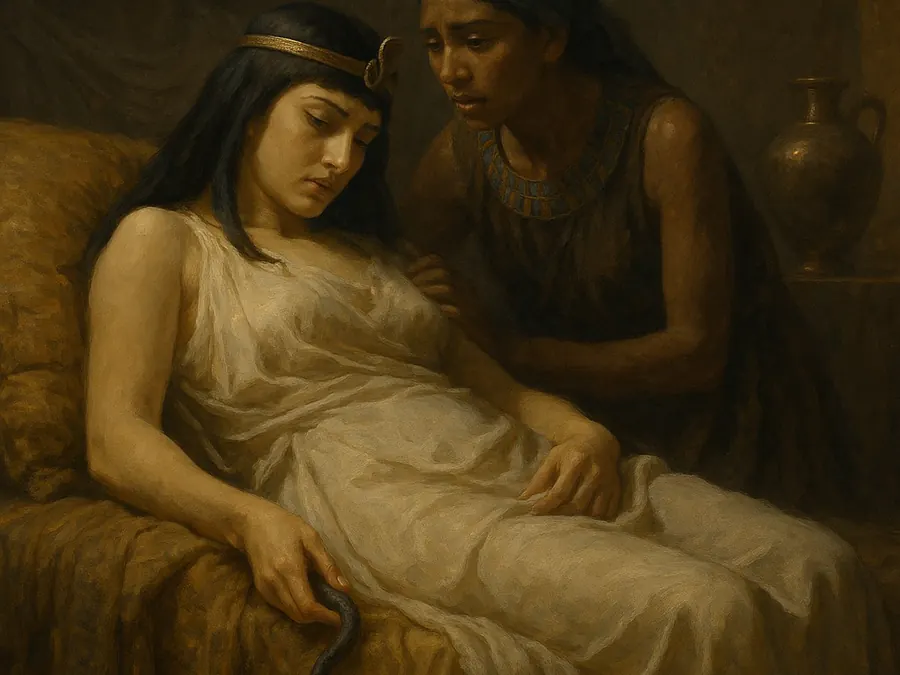
Plutarch also places Cleopatra's attendants Iras and Charmion at the scene. Those details belong to his narrative; they should not be presented as independently verified eyewitness testimony.
Ancient account Suetonius and Cassius Dio do not settle it
Suetonius says Octavian wanted Cleopatra alive for his triumph and called in people who might draw out snake venom after her death. Cassius Dio, writing still later, also reports uncertainty and gives versions involving a snake or a small poisoned instrument. Together, these sources show that the asp story circulated widely in antiquity, but repetition is not the same as forensic confirmation.
Unresolved Could a cobra have done it?
The word “asp” is often interpreted as an Egyptian cobra, although the species is not certain. A University of Manchester zoological assessment argued that concealing and controlling a cobra large enough to kill three adults would have been impractical and that fatal envenomation would not have been guaranteed.
That analysis weakens a literal, highly staged snake scenario; it does not prove a specific poison theory. Some modern scholars consider prepared poison more plausible, but the surviving evidence does not support a firm conclusion.
Why would Cleopatra choose death?
Ancient sources present Cleopatra's death as a way to avoid captivity and display in Octavian's Roman triumph. Suetonius explicitly says Octavian wanted her alive for that purpose. This motive is plausible within those accounts, but her private thoughts were not recorded by a neutral eyewitness.
What the snake image came to mean
The asp recurs in Roman and later European representations of Cleopatra's death. Its repetition helped make the snake version visually familiar, but the artwork cannot settle a method that the surviving written accounts themselves leave uncertain.
Evidence timeline
- 31 BCE: Antony and Cleopatra lose the Battle of Actium.
- August 30 BCE: Octavian captures Alexandria; Antony and then Cleopatra die.
- Early first century CE: Strabo records both asp bite and poisonous ointment.
- Late first to early second century CE: Plutarch records the fig-basket story and competing explanations.
- Early third century CE: Cassius Dio again reports more than one possible method.
Frequently asked questions
Did Cleopatra die from a snake bite?
Possibly, but not certainly. The asp appears in several ancient traditions, while early authors also describe poisonous ointment or a poison-bearing implement.
Did Cleopatra die by suicide?
Most surviving ancient accounts say yes. Because no contemporary forensic evidence survives, a careful answer should say that suicide is the dominant ancient account, not an independently proven medical finding.
Was Cleopatra Egyptian?
She ruled Egypt and presented herself through Egyptian as well as Greek royal traditions. She belonged to the Macedonian Greek Ptolemaic dynasty; the identity of her mother and part of her ancestry remain uncertain. Modern either-or ethnic labels oversimplify her political and cultural identity.
Has Cleopatra's tomb been found?
No tomb has been securely identified as the burial place of Cleopatra and Antony.
Sources
- Strabo, Geography 17.1.10 — early account naming asp bite or poisonous ointment.
- Plutarch, Life of Antony 84, 85, and 86.
- Suetonius, Augustus 17.
- Cassius Dio, Roman History 51.14.
- University of Manchester — zoological assessment of the cobra scenario.
- University College London, Digital Egypt — Roman conquest and administration of Egypt.
- University College London, Digital Egypt — Ptolemy XV Caesarion.
Checked August 10, 2026. Ancient authors wrote within Roman political and literary traditions and are compared here rather than treated as neutral transcripts.
Spotted an error? Tell us — factual corrections are recorded publicly.
Rather listen?
Make history a five-minute habit.
Histia turns moments like this into short narrated stories, free for iPhone and iPad.
- Listen, read, or watch in cinematic mode
- Quick quizzes to make it stick
- A map of history from 3000 BCE to 2025

Free to download · Optional in-app purchases · iOS 18+