Quiz · 20 questions · answers explained
20 history trivia questions with answers, from ancient Egypt to the Moon
Twenty multiple-choice questions on world history, in date order, from the Great Pyramid to the end of the Cold War. Tap an answer to see straight away whether you are right and why; each explanation links to a sourced article if you want the whole story. No sign-up, no timer.
The ancient world
-
The Old Kingdom is called the Age of the Pyramids. Which pharaoh commissioned the Great Pyramid at Giza?
Show the answer
B. Khufu. Khufu's pyramid was completed around 2560 BCE, the largest of the three at Giza. His successors Khafre and Menkaure built the other two.
From the “Ancient Egypt – Old, Middle, New Kingdoms” story in Histia · Full story: How were the Egyptian pyramids built?
-
Who commanded the Athenian force at Marathon?
Show the answer
C. Miltiades. The Athenian commanders were divided on whether to fight at all. Miltiades argued for attacking, prevailed, and Athens won. Leonidas is the Spartan king of Thermopylae, ten years later.
From the “Battle of Marathon” story in Histia · Full story: What happened at the Battle of Marathon?
-
Cleopatra was the last ruler of which dynasty?
Show the answer
A. The Ptolemaic dynasty. The Ptolemies were Macedonian Greeks descended from one of Alexander the Great's generals, and they ruled Egypt for nearly three centuries. Cleopatra was the last active ruler of the line.
From the “Cleopatra VII” story in Histia · Full story: How did Cleopatra die?
-
Which of these happened last?
Show the answer
D. Cleopatra's death. Cleopatra met Caesar in 48 BCE, Caesar was assassinated in 44 BCE, Actium was fought in 31 BCE, and Cleopatra died in August 30 BCE, after which Rome annexed Egypt.
From the “Cleopatra VII” story in Histia · Full story: How did Cleopatra die?
Middle Ages to the Reformation
-
Joan appeared during which long conflict?
Show the answer
C. The Hundred Years' War between England and France. By 1429 the English and their Burgundian allies held Paris and much of the north. Joan's relief of Orléans that May turned the tide of the war.
From the “Joan of Arc” story in Histia · Full story: Who was Joan of Arc?
-
Joan was captured near Compiègne in 1430. By whom?
Show the answer
B. The Burgundians, who sold her on to the English. Burgundy was a French duchy allied with England. Its troops captured Joan in a skirmish in May 1430 and sold her to the English; the king she had crowned made no serious attempt to ransom her.
From the “Joan of Arc” story in Histia · Full story: Who was Joan of Arc?
-
Which mural did Leonardo paint in Milan?
Show the answer
D. The Last Supper. Leonardo painted it on the refectory wall of Santa Maria delle Grazie. The other three are by Raphael, Michelangelo and Botticelli.
From the “Leonardo in Milan” story in Histia · Full story: Leonardo da Vinci: facts behind the genius
-
The Last Supper began deteriorating within Leonardo's own lifetime. Why?
Show the answer
A. He painted on dry plaster with experimental materials instead of using true fresco. True fresco must be painted quickly onto wet plaster. Leonardo wanted to work slowly and revise, so he painted on the dry wall, and the paint began flaking within his lifetime.
From the “Leonardo in Milan” story in Histia · Full story: Leonardo da Vinci: facts behind the genius
-
What practice provoked Luther's 95 Theses in 1517?
Show the answer
C. The sale of indulgences, which promised to reduce the punishment due for sin. The indulgence campaign near Wittenberg helped finance the rebuilding of St Peter's Basilica in Rome. Luther's objection was theological, but it hit a financial nerve.
From the “Martin Luther” story in Histia · Full story: What did Martin Luther do?
-
What did Luther do while in hiding at the Wartburg?
Show the answer
B. Translated the New Testament into German. Outlawed after the Diet of Worms, Luther was hidden by his own prince at Wartburg Castle, where he translated the New Testament from Greek into German in about eleven weeks.
From the “Martin Luther” story in Histia · Full story: What did Martin Luther do?
The 19th century
-
Napoleon was exiled twice. Which island came first?
Show the answer
D. Elba. He was sent to Elba in 1814, escaped in February 1815 and ruled again for the Hundred Days. After Waterloo the allies chose Saint Helena, where he died in 1821.
From the “Napoleon Bonaparte” story in Histia · Full story: Why was Napoleon exiled instead of executed?
-
Which constitutional amendment abolished slavery in the United States?
Show the answer
B. The Thirteenth. It was ratified in December 1865, months after Lincoln's death. The Emancipation Proclamation of 1863 was a war measure; the Thirteenth Amendment did the abolishing.
From the “Abraham Lincoln” story in Histia · Full story: What caused the American Civil War?
The 20th century
-
Where was Einstein working in 1905, the year he published four papers that reshaped physics?
Show the answer
C. The patent office in Bern. Einstein was a 26-year-old technical examiner at the Swiss patent office, having failed to land an academic post after graduating.
From the “Albert Einstein” story in Histia · Full story: Albert Einstein: facts behind the legend
-
Einstein won the Nobel Prize in Physics in 1921. For what?
Show the answer
D. The photoelectric effect. The Nobel committee still thought relativity too unproven. His paper on the photoelectric effect, which treated light as discrete packets of energy, became a foundation of quantum theory.
From the “Albert Einstein” story in Histia · Full story: Albert Einstein: facts behind the legend
-
Britain and France declared war in September 1939. What triggered the declaration?
Show the answer
A. The German invasion of Poland. Britain and France had guaranteed Poland's independence that spring. Earlier German moves, from the Rhineland to Austria and Czechoslovakia, had brought protests but not war.
From the “World War II” story in Histia · Full story: How did World War 2 start?
-
Germany invaded Poland confident that the Soviet Union would not intervene. Why?
Show the answer
C. The two had just signed a pact secretly dividing Eastern Europe between them. The Molotov–Ribbentrop Pact of August 1939 secretly split Eastern Europe between Germany and the Soviet Union. Soviet troops entered Poland from the east on 17 September.
From the “World War II” story in Histia · Full story: How did World War 2 start?
-
The Berlin Airlift of 1948–49 was a response to what?
Show the answer
A. A Soviet blockade of the road and rail routes into West Berlin. For eleven months the Western allies flew food and coal into West Berlin rather than force the roads open. The Berlin Wall came much later, in 1961.
From the “Cold War” story in Histia · Full story: What was the Cold War, really?
-
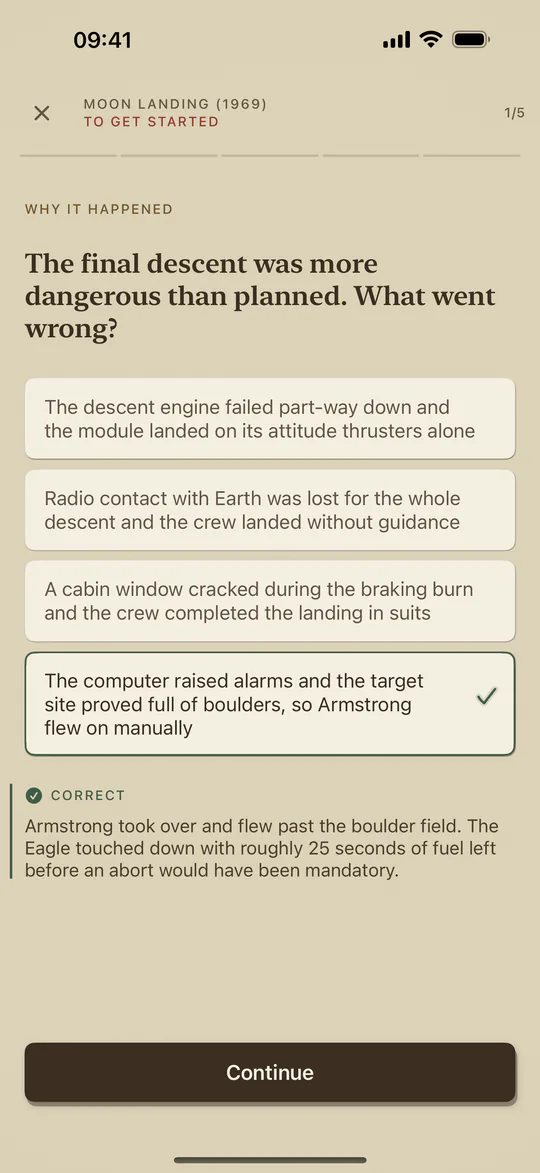
Three men flew Apollo 11, but only two walked on the Moon. What was the third doing?
Show the answer
D. Michael Collins stayed in lunar orbit aboard the command module. Michael Collins orbited alone in the command module, Columbia, while Neil Armstrong and Buzz Aldrin spent about two and a half hours outside on the surface.
From the “Moon Landing (1969)” story in Histia · Full story: Did we really land on the Moon?
-
What was the name of the lunar module that carried Armstrong and Aldrin to the surface?
Show the answer
B. Eagle. “The Eagle has landed” was Armstrong's first message from the surface. Columbia was the command module that Collins kept in orbit.
From the “Moon Landing (1969)” story in Histia · Full story: Did we really land on the Moon?
-
What event in 1991 is taken to mark the end of the Cold War?
Show the answer
A. The dissolution of the Soviet Union. The Berlin Wall fell in 1989 and Germany reunified in 1990, but the Cold War is usually dated to the dissolution of the Soviet Union itself, in December 1991.
From the “Cold War” story in Histia · Full story: Why did the Soviet Union collapse?
Want more?
196 more questions are waiting in Histia.
Each quiz follows a five-minute narrated story, so you hear the history before you are tested on it, and every answer is explained.
- 216 written questions across 27 stories
- 78 stories to listen to, read, or watch
- A map of history from 3000 BCE to 2025

Free to download · Optional in-app purchases · iPhone & iPad · iOS 18+