Reference list · 15 events
The most important events in world history
Any list of the "most important events in history" is an argument, not a fact — so here is ours, stated openly: these 15 events are the ones whose consequences still structure your daily life, from the alphabet you're reading to the borders on today's map. Each entry says what changed and links to a full, sourced article where we have one. For the wider picture, all of these sit on our free interactive timeline of 69 turning points, grouped into seven eras and filterable by type.
How events made this list
One filter matters above all: durable, worldwide consequence. An event qualifies if subtracting it plausibly changes how most humans live now — not merely who ruled a country for a generation. That test favors slow revolutions (writing, printing, industry) over famous battles, which is why some celebrated dates are missing. Where a war does appear, it's because its settlement rewired the world order. The list runs chronologically, not by rank.
From writing to the fall of Rome
- Writing is invented in Sumer (c. 3200 BCE) — accounting marks on clay become the technology of memory itself; history, law, and literature all start here. An episode in the app tells the story.
- Athens invents democracy (508 BCE) — flawed and narrow, but the precedent that ordinary citizens can rule themselves never stopped echoing.
- The Silk Road opens (c. 130 BCE) — Eurasia's halves begin trading goods, faiths, and plagues; globalization's first draft. What was the Silk Road?
- Julius Caesar is assassinated (44 BCE) — the Republic's death and the Empire's birth; the template of every strongman story since. Who killed Caesar?
- The Western Roman Empire falls (476 CE) — Europe fragments into the pieces that eventually become its nations. Why did Rome fall?
The medieval and early modern turns
- Magna Carta is sealed (1215) — the first durable, written assertion that the ruler is under the law; due process descends from it. What is the Magna Carta?
- Gutenberg's printing press (c. 1440) — information becomes cheap and uncensorable at scale; everything after — Reformation, science, revolutions — runs on it. How printing changed the world.
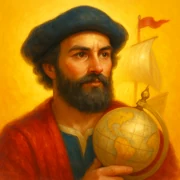
- Columbus crosses the Atlantic (1492) — two hemispheres collide, at catastrophic cost to one; crops, people, and power flow along the new route. Did Columbus discover America?
- Luther's 95 theses (1517) — Western Christianity splits, and with it the idea that any single authority can own truth. What did Martin Luther do?
The making of the modern world
- The Industrial Revolution begins (c. 1760s) — energy stops meaning muscle; sustained economic growth exists for the first time. When did it start?
- The Bastille is stormed (1789) — the modern political vocabulary — rights, nation, left and right — enters the world stage. What caused the French Revolution?
- World War 1 begins (1914) — four empires fall, and the unresolved peace loads the next war. What caused WW1?
- World War 2 begins (1939) — the deadliest war in history ends with the bomb, the UN, and a bipolar world. How did WW2 start?
- Apollo 11 lands on the Moon (1969) — the first time life leaves its planet and walks on another world. Did we really land on the Moon?
- The Berlin Wall falls (1989) — the Cold War ends without the war, and today's world order dates from that night. Why did the Wall fall?
What didn't make the cut — and why
No agricultural revolution (too gradual for a "date"), no religious founding (consequence beyond argument, but this is a history list, not a theology ranking), no single battle before 1914 (settlements, not battles, change how people live), and nothing from the last thirty years — importance needs distance to measure. If your candidate is missing, the odds are it failed the "does daily life change without it?" test — or that we simply judged the call differently, which is what the corrections page is for.
Frequently asked questions
What is the single most important event in world history?
By the test used here — durable effect on how most humans live — the strongest candidates are the slow ones: the invention of writing, the printing press, and the Industrial Revolution. Writing arguably wins, since every other entry on the list depends on it to be remembered at all.
Why isn't [famous battle] on the list?
Because battles rarely pass the daily-life test on their own: their consequences flow through the settlements and systems they enable. Hastings changed England's ruling class; the printing press changed every literate human. Where a war appears here, it's for the world order it produced, not the fighting itself.
Is this list Eurocentric?
Partly, and we'd rather admit it than pretend otherwise. Several entries (writing, the Silk Road, the World Wars, the Moon landing) are global by nature, but the middle of the list tracks Europe's outsized modern footprint — printing, 1492, industry — which is itself a historical fact with causes. Counter-suggestions that pass the consequence test are genuinely welcome.
Walk the whole timeline in five-minute stories
Most of these turning points are five-minute episodes in Histia — with narration, cinematic playback, quizzes, and a map running from 3000 BCE to today. Free on the App Store for iPhone and iPad (iOS 18+).
Download Histia Free