Cold War · 9 November 1989
Why Did the Berlin Wall Fall?
The Berlin Wall fell on the night of 9 November 1989, opened by its own guards after a botched press conference: East German spokesman Günter Schabowski, handed new travel rules he hadn't read, announced they took effect "immediately, without delay." Tens of thousands of East Berliners surged to the crossings until the outnumbered guards raised the barriers. Behind that accident stood real causes: a bankrupt East German state, Gorbachev's refusal to intervene, Hungary's opened border, and months of growing peaceful mass protests.
Key facts
- The Wall stood for 28 years (1961–1989); before it was built, about 3.5 million East Germans — a sixth of the population — had left through Berlin.
- At least 140 people died at the Berlin Wall itself, and several hundred more along the wider inner-German border, trying to reach the West.
- Its official East German name was the "Anti-Fascist Protection Rampart" — a wall officially built to keep enemies out, whose defenses all faced inward.
- By October 1989, the Leipzig Monday demonstrations had swelled to hundreds of thousands chanting "Wir sind das Volk" — "We are the people" — and the regime no longer dared shoot.
- Schabowski's fumbled answer — "as far as I know… immediately, without delay" — went out live at 18:57; by midnight the crossings were open (the night, hour by hour). Not a single shot was fired.
- Germany reunified less than a year later, on 3 October 1990; the USSR itself dissolved by the end of 1991.
Why the Wall existed at all
The Wall was built to stop an exodus. After WWII, occupied Germany split into a Soviet-controlled East (the GDR) and a Western-aligned West; Berlin, deep inside the East, was itself divided. Through the 1950s the GDR hemorrhaged citizens — engineers, doctors, the young — who could simply walk into West Berlin and fly out. By 1961 some 3.5 million had gone, and the state was bleeding to death. On the night of 13 August 1961, East German troops unrolled barbed wire across the city; the wire became concrete, then a fortified death strip of watchtowers, dogs, and tripwire guns. Families were split mid-street. For 28 years the Wall worked, at the price of becoming the Cold War's most photographed indictment: a state that had to cage its citizens to keep them.
The system cracks: Gorbachev, Hungary, Leipzig
The Wall's foundations were never concrete — they were Soviet tanks, which had crushed uprisings in Berlin (1953), Hungary (1956), and Czechoslovakia (1968). When Mikhail Gorbachev took power in 1985, inheriting a Soviet economy buckling under stagnation and the arms race, he renounced exactly that: his reforms (glasnost, perestroika) came with a message to satellite regimes that Moscow would no longer intervene to save them. Poland held semi-free elections in June 1989 and Solidarity crushed the communists; Moscow did nothing. The precedent was set.
Then Hungary opened a hole in the Iron Curtain, dismantling its border fence with Austria in May 1989 — and by summer, East Germans were "vacationing" in Hungary by the tens of thousands and walking west. Others crammed into West German embassies in Prague and Warsaw. Inside the GDR, protest went from prayer meetings to mass marches: the Leipzig Monday demonstrations grew from hundreds to 70,000 on 9 October — the night the regime's threatened crackdown never came — to over 300,000. The chant said everything: Wir sind das Volk. We are the people. On 18 October the party sacked its hardline leader Erich Honecker, scrambling to survive.
November 9: the press conference that ended an era
Desperate to release pressure, the new leadership drafted regulations allowing citizens to apply for travel visas — a controlled valve, meant to start the next day with paperwork and approvals. The task of announcing it fell to Politburo member Günter Schabowski, who arrived at a live evening press conference having skimmed the memo. Asked when the rules took effect, he shuffled his papers and improvised the most consequential wrong answer of the century: "As far as I know… immediately, without delay." Asked if that included West Berlin: yes.
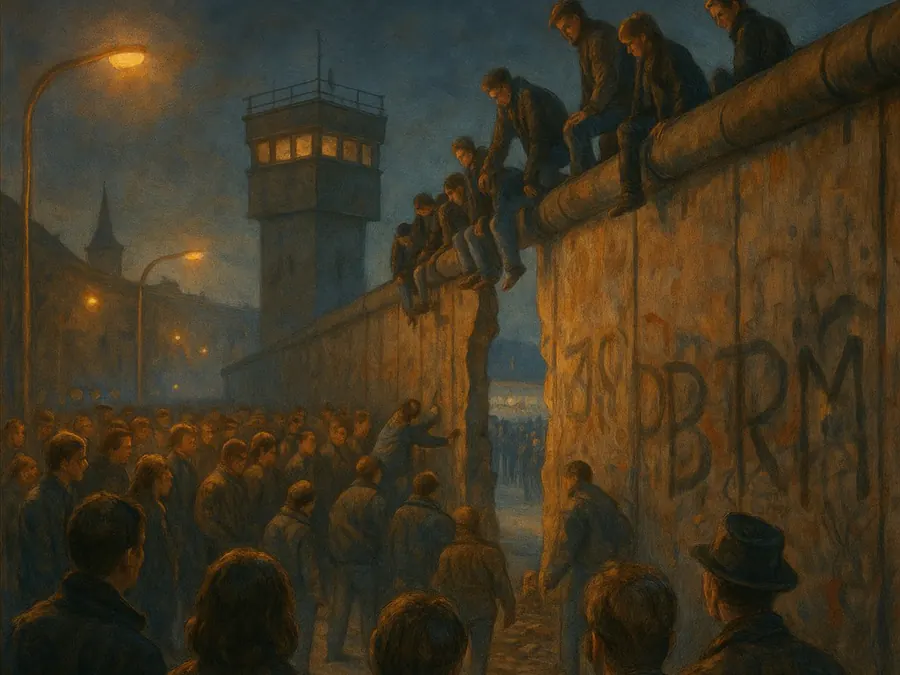
Western TV — which East Germans watched nightly — announced the Wall was open. Within hours, crowds tens of thousands strong stood at the crossings chanting "Open the gate!" The border guards had no orders, no instructions, and shrinking options. At the Bornholmer Straße crossing, around 23:30, commander Harald Jäger — unable to reach any superior willing to decide — opened the barrier. The other crossings followed. Strangers wept, danced on the Wall at the Brandenburg Gate, and attacked the concrete with hammers. The most fortified border in Europe fell in one night without a shot.
The night of 9 November 1989, hour by hour
Berlin time. Accounts differ by a few minutes on some of these; the times below follow the Berlin city government, Germany's Federal Agency for Civic Education and the Bundestag's weekly Das Parlament.
- Schabowski's press conference begins, live on East German television.
- He reads out the new travel rules. Asked when they take effect: "As far as I know… immediately, without delay."
- The press conference ends. At 19:04 the West German agency dpa reports that East Germans can cross "immediately".
- West German television's main news, the Tagesschau, leads with it: the GDR opens its border. East Germans watch it too.
- At Bornholmer Straße, with the crowd growing, guards start letting the most insistent out, under orders not to tell them they will not be let back in.
- On the late news, Tagesthemen, Hanns Joachim Friedrichs calls 9 November a historic day and says the gates in the Wall stand wide open. They do not, yet; the broadcast sends thousands more to the crossings.
- Harald Jäger, the officer in charge at Bornholmer Straße, has the barrier opened for everyone. Around 20,000 people cross in the next hour.
- The other inner-city crossings open one after another. On 10 November people stand on the Wall in front of the Brandenburg Gate.
What came after — and why it still matters
The Wall's fall unleashed a cascade nobody could stop: within weeks, communist governments collapsed in Czechoslovakia, Bulgaria, and Romania; within eleven months, Germany reunified (3 October 1990); within two years, the Soviet Union itself voted out of existence. The Cold War, which had threatened nuclear annihilation for four decades, ended not with missiles but with candles, crowds, and a bureaucrat's fumbled cue card.
The deeper lesson historians draw: the accident only worked because the structure was rotten. A solvent, confident regime survives a botched press conference. One that is bankrupt, abandoned by its patron, and facing its own people in the streets, does not. Fragments of the Wall now stand in museums on every continent — souvenirs of the year people discovered that some walls are weaker than they look.
Timeline at a glance
- 13 Aug 1961 — East Germany seals the border overnight; the Wall goes up
- 1985 — Gorbachev takes power in Moscow; reform era begins
- May 1989 — Hungary starts dismantling its border fence with Austria
- 9 Oct 1989 — 70,000 march peacefully in Leipzig; the feared crackdown never comes
- 9 Nov 1989 — Schabowski's press conference; crossings open by midnight
- 3 Oct 1990 — German reunification
- 26 Dec 1991 — The Soviet Union is dissolved
Frequently asked questions
When did the Berlin Wall fall?
On the night of Thursday 9 November 1989. Schabowski's announcement went out live just before 19:00, the Bornholmer Straße crossing opened for everyone at about 23:30, and the other Berlin crossings followed through the night. The concrete came down later: official demolition began on 13 June 1990.
How long did the Berlin Wall stand?
28 years: from 13 August 1961 to 9 November 1989, or 10,315 days. On 5 February 2018 the Wall had been gone for as long as it had stood.
Who actually opened the Berlin Wall?
No one ordered it. After Schabowski's mistaken 'immediately' on live TV, crowds overwhelmed the crossings. At Bornholmer Straße, border commander Harald Jäger — receiving no usable orders from superiors — decided around 23:30 to raise the barrier rather than risk a massacre. Other crossings followed within the hour.
How many people died trying to cross the Berlin Wall?
Research documents at least 140 deaths at the Berlin Wall itself between 1961 and 1989 — shot, drowned in border waterways, or killed in accidents during escape attempts — with several hundred more along the wider inner-German border.
Why didn't the Soviet Union stop the Wall from falling?
Because Gorbachev had already decided the empire wasn't worth saving by force. With the Soviet economy failing, he had renounced military intervention in satellite states — a reversal of the doctrine that had crushed uprisings in 1953, 1956, and 1968. When the Wall opened, the 380,000 Soviet troops in East Germany stayed in their barracks.
Sources & further reading
This article was written from the published record. Every link below was checked and is live:
- Stiftung Berliner Mauer — Berlin Wall Memorial (official)
- Wikipedia — Berlin Wall
- Wikipedia — Peaceful Revolution
- Wikipedia — Günter Schabowski
- Berlin.de — Öffnung und Fall der Mauer (times at Bornholmer Straße, in German)
- bpb — Deutschland-Chronik: 9. November 1989 (in German)
Spotted an error? Tell us — corrections are logged and the update date above is revised.
Rather listen?
Hear “Fall of the Berlin Wall 1989” as a five-minute story.
It is a narrated story in Histia, the free history app for iPhone and iPad.
- Listen, read, or watch in cinematic mode
- Read along with the narration
- A map of history from 3000 BCE to 2025
Free to download · Optional in-app purchases · iOS 18+