Modern era · 1914–1918
What Caused World War 1?
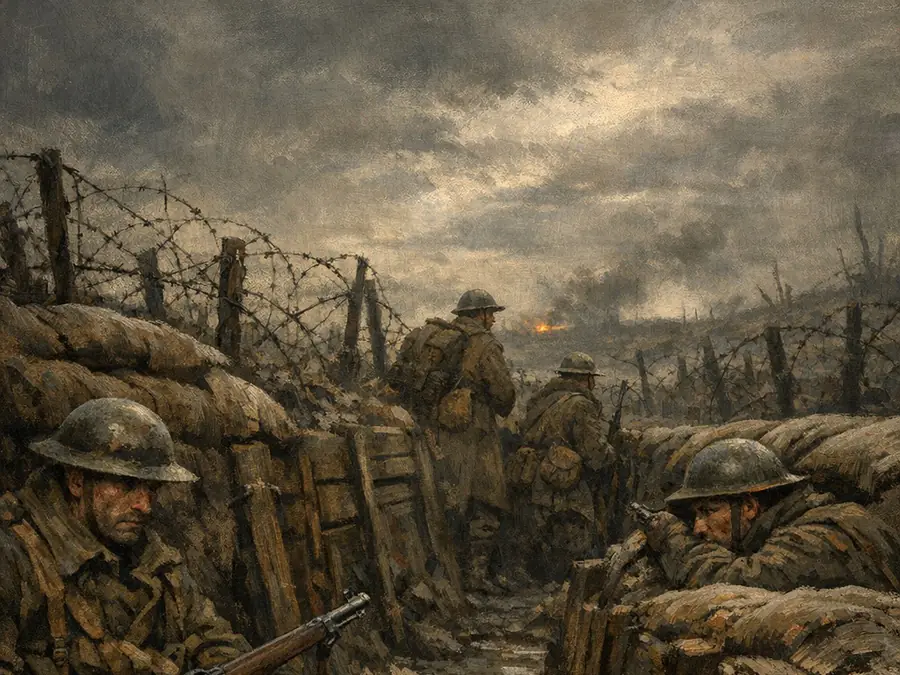
World War I was triggered by the assassination of Archduke Franz Ferdinand in Sarajevo on 28 June 1914 — but the murder was only the spark. The deeper causes were a rigid alliance system that turned a local Balkan dispute into a continental war, an unchecked arms race, imperial rivalry, and surging nationalism. Within six weeks, the "July Crisis" escalated step by step until, by early August 1914, every major European power was at war.
Key facts
- The war killed roughly 17 million people — about 10 million soldiers and 7 million civilians — and wounded over 20 million more.
- The assassination nearly failed: a first bomb missed, and Gavrilo Princip only got his chance because the Archduke's driver took a wrong turn and stalled the car in front of him.
- Germany's "blank cheque" of 5 July 1914 — unconditional backing for Austria-Hungary — turned a Balkan quarrel into a great-power confrontation.
- Mobilization timetables ran on railway schedules so rigid that leaders felt unable to pause without handing the enemy a fatal head start.
- Four empires did not survive the war: the German, Austro-Hungarian, Russian, and Ottoman empires all collapsed by 1918–1922.
The spark: murder in Sarajevo
On 28 June 1914, Archduke Franz Ferdinand — heir to the Austro-Hungarian throne — visited Sarajevo, capital of recently annexed Bosnia. Seven young Bosnian Serb nationalists, armed by the Serbian secret society known as the Black Hand, waited along his route. The plot nearly fizzled: one conspirator's bomb bounced off the Archduke's car and wounded officers in the vehicle behind. Franz Ferdinand insisted on visiting the wounded — and his driver, uninformed of the changed route, turned down a side street and braked directly in front of 19-year-old Gavrilo Princip, who fired twice, killing the Archduke and his wife Sophie.
Europe had absorbed royal assassinations before without general war. What made this one different was not the act itself but the decisions taken in the five weeks that followed.
The powder keg: four deep causes
Historians summarize the underlying conditions with four intertwined forces. Alliances: Europe had hardened into two blocs — the Triple Alliance (Germany, Austria-Hungary, Italy) and the Triple Entente (France, Russia, Britain) — designed to deter war, but wired so that one bilateral conflict would drag in everyone. Militarism: two decades of arms racing, above all the Anglo-German naval race and the doubling of continental armies, had convinced general staffs that war was inevitable and best fought soon. Imperialism: rival colonial ambitions in Africa and Asia had brought repeated near-misses (Morocco 1905 and 1911). Nationalism: pan-Slavism in the Balkans, revanchism in France over Alsace-Lorraine, and prestige politics everywhere made compromise look like humiliation.
Beneath all four lay the Balkans themselves — two recent Balkan Wars (1912–13) had carved up Ottoman Europe and left Serbia enlarged, Austria-Hungary alarmed, and Russia committed to its Slavic client.
The July Crisis: five weeks to catastrophe
The escalation was a chain of choices, each defensible to its maker, catastrophic in sum. Austria-Hungary, determined to crush Serbia, first secured Germany's unconditional support — the infamous "blank cheque" of 5 July. On 23 July Vienna delivered an ultimatum designed to be rejected; Serbia accepted nearly all of it anyway. Not enough: Austria-Hungary declared war on 28 July and shelled Belgrade the next day.
Then the alliance gears engaged. Russia mobilized to protect Serbia (30 July); Germany, whose Schlieffen Plan required beating France before slow-mobilizing Russia was ready, declared war on Russia (1 August) and France (3 August), and invaded neutral Belgium to outflank the French army. Belgium's violated neutrality gave Britain its cause — and its legal obligation — to declare war on 4 August. In 37 days, a provincial murder had become a world war. As the German chancellor Bethmann Hollweg despaired, the powers had "stumbled" — though modern historians stress they were pushed by leaders who gambled, each expecting the other side to back down.
Could it have been stopped?
Probably — at several points. If Vienna had struck Serbia immediately in July while sympathy was fresh, the war might have stayed local. If Germany had restrained its ally instead of handing it a blank cheque; if Russia had delayed mobilization; if Britain had declared its position earlier, deterring Berlin — any one link breaking might have held the chain. That is precisely why the July Crisis remains the most-studied five weeks in diplomatic history, and why its lesson — how rigid plans, worst-case thinking, and prestige can make war feel "inevitable" — was invoked from the Cuban Missile Crisis onward.
Instead, the war ran four years, killed some 17 million people, toppled four empires, and planted — at Versailles and in the trauma of a generation — the seeds of an even larger war twenty years later.
Timeline at a glance
- 28 Jun 1914 — Franz Ferdinand assassinated in Sarajevo by Gavrilo Princip
- 5 Jul 1914 — Germany's "blank cheque" of support to Austria-Hungary
- 28 Jul 1914 — Austria-Hungary declares war on Serbia
- 1–3 Aug 1914 — Germany declares war on Russia, then France
- 4 Aug 1914 — Germany invades Belgium; Britain declares war
- 11 Nov 1918 — Armistice — roughly 17 million dead
Frequently asked questions
What was the main cause of World War 1?
No single cause suffices. The assassination of Franz Ferdinand was the trigger, but the alliance system converted a local Austro-Serbian dispute into a continental war, while militarism, imperial rivalry, and nationalism had loaded the continent for conflict. Most historians assign special weight to the decisions of the July Crisis — above all Germany's blank cheque and Austria-Hungary's determination for war.
Which countries fought in WW1?
The Central Powers — Germany, Austria-Hungary, the Ottoman Empire, and Bulgaria — against the Allies, principally France, Russia, Britain and its empire, Serbia, Belgium, Italy (from 1915), and the United States (from April 1917). Fighting spread to Africa, the Middle East, Asia, and every ocean.
How many people died in World War 1?
Roughly 17 million: about 10 million military dead and 7 million civilians, with over 20 million wounded. The 1918 influenza pandemic that spread through wartime mobilization killed tens of millions more worldwide.
Sources & further reading
This article was written from the published record. Every link below was checked and is live:
- World History Encyclopedia — World War I
- Wikipedia — Causes of World War I
- Wikipedia — July Crisis
- Wikipedia — Assassination of Archduke Franz Ferdinand
Spotted an error? Tell us — corrections are logged and the update date above is revised.
Rather listen?
Hear “World War I” as a five-minute story.
It is a narrated story in Histia, the free history app for iPhone and iPad.
- Listen, read, or watch in cinematic mode
- Read along with the narration
- A map of history from 3000 BCE to 2025

Free to download · Optional in-app purchases · iOS 18+