Modern era · 1939–1945
How Did World War 2 Start?
In Europe, World War II began when Germany invaded Poland on 1 September 1939; Britain and France declared war two days later. In Asia it had effectively begun earlier, with Japan's full-scale invasion of China in 1937. The road to war ran through the punitive Treaty of Versailles, the Great Depression, Hitler's rise in 1933, and six years of failed appeasement as Germany rearmed and swallowed its neighbors.
Key facts
- World War II became the deadliest conflict in human history: 70–85 million dead, the majority of them civilians.
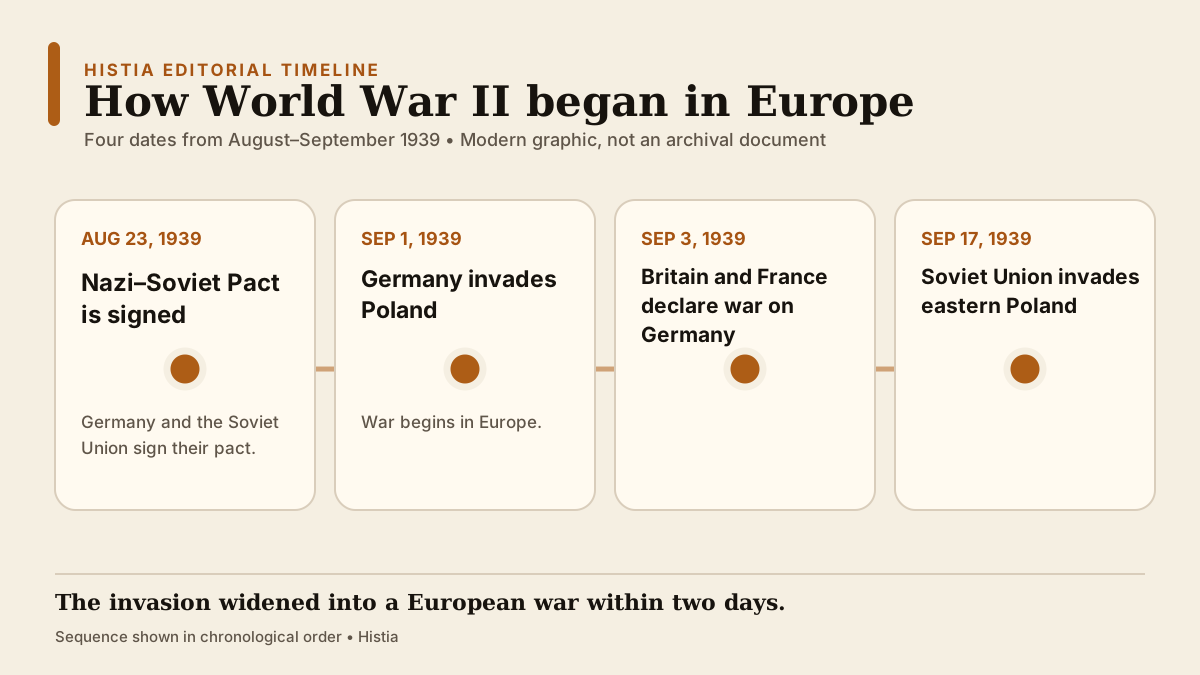
- One week before invading Poland, Nazi Germany and the Soviet Union stunned the world with the Molotov–Ribbentrop Pact — including a secret protocol dividing Eastern Europe between them.
- Britain's PM Neville Chamberlain returned from Munich in 1938 declaring "peace for our time"; Germany dismembered Czechoslovakia within six months.
- The Soviet Union also invaded Poland, from the east, on 17 September 1939 — a fact often forgotten in the war's popular retelling.
- The United States stayed formally neutral for over two years, entering only after Pearl Harbor, 7 December 1941 — after which Hitler declared war on the US first.
The long fuse: Versailles, Depression, and the rise of fascism
The Second World War is impossible to explain without the First. The 1919 Treaty of Versailles stripped Germany of territory and colonies, capped its army at 100,000 men, and — most corrosively — forced it to accept sole guilt and pay massive reparations. The treaty was harsh enough to humiliate but not harsh enough to permanently disable, and the grievance it bred became the most powerful recruiting tool of German nationalism.
The Great Depression did the rest. After 1929, German unemployment passed six million, and voters abandoned the center for the extremes. In January 1933 Adolf Hitler was appointed chancellor; within eighteen months he had destroyed German democracy. His program was never secret: overturn Versailles, rearm, unite all Germans, and seize "living space" in the east. Meanwhile Japan, seeking resources and empire, had taken Manchuria in 1931 and launched total war on China in 1937, and Mussolini's Italy had invaded Ethiopia — the international order was failing everywhere at once, and the League of Nations proved powerless each time.
Appeasement: six years of one-way concessions
Britain and France, traumatized by 1914–18 and hoping Hitler was a normal statesman with limited aims, chose negotiation over confrontation. The record reads like a staircase: 1935, Germany openly rearms — no response. March 1936, German troops re-enter the demilitarized Rhineland — no response. March 1938, Germany annexes Austria (the Anschluss) — no response. September 1938, at Munich, Britain and France hand Hitler the Sudetenland, the fortified border region of Czechoslovakia, without consulting the Czechs — in exchange for his promise that he sought no more territory.
In March 1939 Hitler broke that promise, occupying the rest of the Czech lands. Appeasement was dead: Britain and France issued a formal guarantee to his obvious next target, Poland. The question was no longer whether Hitler would strike, but whether Stalin would stop him — and in August 1939 came the answer that made war certain: the Molotov–Ribbentrop Pact, a Nazi–Soviet non-aggression treaty whose secret clauses carved Poland and the Baltics into German and Soviet spheres. Hitler now had a free hand in the east.
September 1939: the war begins
At dawn on 1 September 1939, after a staged "Polish attack" on a German radio station at Gleiwitz, some 1.5 million German troops crossed the Polish border, backed by the Luftwaffe's devastating close air support — the debut of what the world would call Blitzkrieg. Britain and France declared war on 3 September, but could do little for Poland itself; on 17 September the Red Army invaded from the east per the secret protocol, and by early October Poland was partitioned between the two dictatorships.
There followed the strange lull of the "Phoney War" — until spring 1940, when Germany overran Denmark, Norway, the Netherlands, Belgium, and, in six shocking weeks, France. What began as a European war became truly global in 1941: Hitler invaded the Soviet Union in June, and Japan struck Pearl Harbor on 7 December, bringing in the United States. By then, the war that "started" in Poland had many start dates — 1931 in Manchuria, 1937 in China, 1939 in Europe — a reminder that the world caught fire in stages, while those who could have doused it early looked away.
Timeline at a glance
- 1919 — Treaty of Versailles imposes territorial losses, disarmament, and reparations on Germany
- Jan 1933 — Hitler appointed Chancellor of Germany
- 1936–38 — Rhineland remilitarized; Austria annexed; Munich Agreement cedes the Sudetenland
- 23 Aug 1939 — Molotov–Ribbentrop Pact: Nazi–Soviet deal secretly divides Eastern Europe
- 1 Sep 1939 — Germany invades Poland; Britain and France declare war on 3 September
- 7 Dec 1941 — Japan attacks Pearl Harbor; the war becomes fully global
Frequently asked questions
When did World War 2 officially start?
The conventional date is 1 September 1939, when Germany invaded Poland, with Britain and France declaring war on 3 September. Many historians add that the Asian war began with Japan's invasion of China in July 1937 — and some trace the chain back to Manchuria in 1931.
Why didn't Britain and France stop Hitler earlier?
A mix of war trauma, economic depression, military unreadiness, fear of communism, and wishful thinking. Each German move — rearmament, the Rhineland, Austria, Munich — seemed individually not worth a war. By the time the pattern was undeniable in March 1939, Germany had grown far stronger than in 1936, when it could have been stopped cheaply.
When did the United States enter WW2?
After Japan attacked Pearl Harbor on 7 December 1941. The US declared war on Japan the next day; Germany and Italy declared war on the US on 11 December. Before that, America had aided Britain through Lend-Lease while remaining formally neutral.
Sources & further reading
This article was written from the published record. Every link below was checked and is live:
- United States Holocaust Memorial Museum — World War II: key dates
- United States Holocaust Memorial Museum — Invasion of Poland, Fall 1939
- United States Holocaust Memorial Museum — World War II in Europe
- World History Encyclopedia — World War II
- Wikipedia — Causes of World War II
- Wikipedia — Molotov–Ribbentrop Pact
- Wikipedia — Munich Agreement
Spotted an error? Tell us — corrections are logged and the update date above is revised.
Rather listen?
Hear “World War II” as a five-minute story.
It is a narrated story in Histia, the free history app for iPhone and iPad.
- Listen, read, or watch in cinematic mode
- A quick quiz to lock it in
- A map of history from 3000 BCE to 2025
Free to download · Optional in-app purchases · iOS 18+