
Daily learning method
How to learn history in 5 minutes a day
Use five minutes as a practical boundary, not a magic number: answer one narrow historical question, close the material and recall the answer, then check and correct it. Repeat across the week while adding context. The seven-day plan below gives you an exact task for every session.
By the end of this guide, you can
- turn a broad topic into one answerable question;
- run a five-minute learn → recall → correct session;
- use a seven-day sequence that adds context instead of collecting disconnected facts;
- recognize when the subject needs a longer source.
Five minutes is a boundary, not an optimum
A short session can make the next task easier to see and easier to schedule. Research on distributed practice supports revisiting material across separate sessions, while retrieval-practice experiments support attempting to recall what you studied under their tested conditions. Neither body of research establishes five minutes as the ideal duration for every subject, learner or goal.
That distinction protects the method from hype. Five minutes may be enough for one focused question. It is not enough for a full account of the French Revolution, the Atlantic slave trade or the collapse of the Soviet Union. When the question cannot be answered without removing essential context, make the session longer or narrow the question.
If you are still deciding whether the subject deserves a place in your day, begin with why history is worth learning. This guide stays focused on the practical method.
The exact five-minute session
| Time | Action | Example |
|---|---|---|
| 0:00–0:30 | Choose one question. | “Why was Abraham Lincoln assassinated?” rather than “Learn the American Civil War.” |
| 0:30–3:30 | Read or listen for the people, sequence and central explanation. | Ignore side facts that do not help answer today's question. |
| 3:30–4:15 | Close the material and retrieve. | Say the answer in one sentence, then name two supporting details. |
| 4:15–5:00 | Check and correct. | Reopen the text, fix one error and mark any disputed point for deeper reading. |
This timing is a usable template created for this guide, not a tested scientific prescription. If recall takes longer or a source raises a new question, continue when you have time instead of racing the clock.

Your concrete 7-day history plan
Choose one narrow subject for the whole week. Staying with it lets each session add a different layer instead of producing seven unrelated facts.
Day 1 · Core answer
Find the spine
Read or listen to one short, sourced explanation. Without looking, write the answer in one sentence and add two details.
Day 2 · Retrieval
Answer before reviewing
Try yesterday's answer from memory first. Check it only afterward and correct what changed or disappeared.
Day 3 · Context
Add what came before
Identify one earlier condition the first answer depends on. Connect it with the word “because,” “although,” or “therefore.”
Day 4 · Sequence
Put three steps in order
Name what happened before, during and after the turning point. Check dates only after building the sequence.
Day 5 · Evidence
Inspect one source
Open a museum, archive, university or government source. Record what it supports—and what it does not establish.
Day 6 · Explanation
Teach it without notes
Explain the question aloud in sixty seconds. If you cannot connect two facts, mark the gap instead of guessing.
Day 7 · Synthesis
Write and verify
Write a short paragraph from memory, check every factual claim, then list one question that still needs longer study.
The method in one line: one question, one answer from memory, one correction—then return with a new layer tomorrow.
Three rules that prevent shallow learning
- Keep a common thread. A week about one event or person builds relationships; seven random facts rarely do.
- Recall before rereading. Looking at the answer can create familiarity. Trying first reveals what you can actually produce without the page.
- Separate evidence from confidence. If a claim is disputed or unsupported, write that uncertainty down. Confidence is not a source.
Check the method
What should happen before you reopen the material?
Try to answer the focused question from memory. Then reopen the material to verify and correct your response.
Why keep one topic across the week?
Each session can add context, sequence, evidence and explanation to the same mental structure instead of leaving isolated facts.
When should you abandon the five-minute limit?
When answering honestly requires more context, competing interpretations, close reading or source comparison than the short session can hold.
How Histia fits—without replacing deeper study
Histia can supply the bounded starting unit: published stories include narration and synchronized text, most include a short quiz round, and the current app records a streak. A story can start the session and a quiz can provide one recall attempt. The streak records that you returned; it does not measure historical understanding.
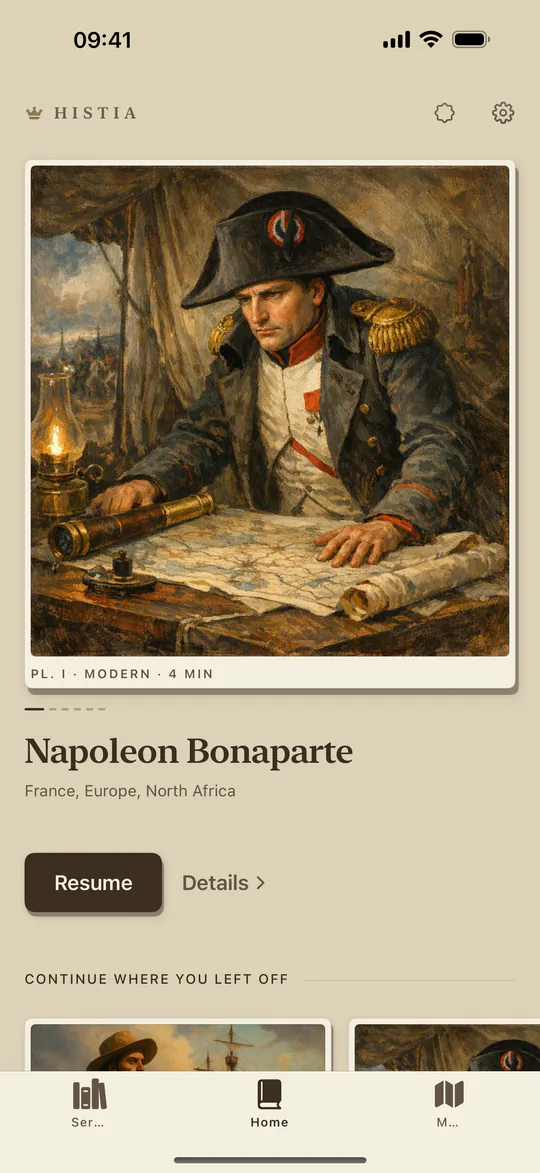
Try the first five-minute session in Histia
Choose one story, recall its central point, then check yourself. Histia is free to download for iPhone and iPad (iOS 18+), with optional in-app purchases.
Start one focused storyCan I really learn history without long study sessions?
Short sessions can build familiarity over time, especially when you return to the material and attempt recall. They cannot supply all the context or evidence a complex subject requires, so use longer, sourced material when you want depth.
What if I miss a day?
Resume when you can. A streak is a prompt, not evidence that learning has failed after one missed day.
Research referenced
The studies below support spacing and retrieval under specific conditions. They do not establish five minutes as a universal optimum or evaluate Histia.
- Cepeda et al. (2006), distributed-practice review and quantitative synthesis.
- Roediger and Karpicke (2006), retrieval-practice experiments.
- Histia: World History Facts — US App Store listing, checked August 25, 2026, for platform and purchase information.
Set up your next five-minute session in Histia
- Before your break, pick one available story from the library or a themed series. Choosing in advance keeps your learning window from becoming browsing time.
- Check the duration. If it runs longer than your break, plan to pause and resume; five minutes is your available time, not a promise about every episode.
- Use narration or read the text. Listen for one cause, one decision, and one consequence rather than trying to collect every date.
- At the stopping point, say one sentence from memory. On your next visit, recall that sentence before choosing a related story or an available quiz.
Your first goal is simple: complete one small session and know where to continue. The seven-day plan above gives that routine a subject and a direction.
Get Histia for your daily history session
Free to download · Optional in-app purchases · iPhone & iPad · iOS 18+