Historical thinking
Why is history important? 7 practical reasons it matters today
History is important because it helps us explain how the present came to be, trace change and causation, test claims against evidence, and encounter perspectives beyond our own. It does not predict the future or provide automatic lessons. Its value is more practical: it gives us documented cases of human choices and consequences, and a disciplined way to question simple stories.
By the end of this guide, you can
- distinguish the past, historical sources, and the accounts historians build;
- explain seven practical reasons for learning history;
- recognize what historical comparison can—and cannot—tell us;
- start with one useful question instead of trying to learn everything at once.
What history is—and what it is not
The past is everything that happened before the present. History is the attempt to understand parts of that past by asking questions, examining surviving sources, comparing interpretations, and building arguments that fit the evidence. The University of Basel describes the discipline as an inquiry into past events, processes, and structures conducted from questions in the present.
That means history is not simply a warehouse of settled facts. Sources are incomplete, people create them for particular purposes, and later researchers bring new questions. Interpretation is unavoidable, but that does not mean every interpretation is equally convincing. Evidence, context, corroboration, and transparent reasoning create limits.
| Layer | What it means | A useful question |
|---|---|---|
| The past | Events, lives, structures, and experiences as they occurred. | What happened? |
| Sources | Documents, objects, images, testimony, data, and other traces that survive. | Who created this, when, why, and for whom? |
| History | Evidence-based explanations and interpretations of the past. | Which account best fits the available evidence, and what remains uncertain? |
Seven reasons history still matters today
1. It explains how the present was made
Institutions, borders, technologies, customs, and conflicts did not appear fully formed. History traces the decisions and conditions that produced them. A present-day fact becomes easier to understand when you can see the sequence behind it.
Consider communication. Learning how printing changed the movement of texts in Europe reveals that today's information systems belong to a much longer history of production, access, authority, and disruption. The comparison does not make a printing press identical to the internet. It gives us a better set of questions about what changes when information becomes easier to reproduce.
2. It reveals change—and what persists
Historical thinking pays attention to both change and continuity. Laws can change quickly while habits, inequalities, or institutions persist. A timeline helps establish order, but the deeper question is why some developments accelerated while others resisted change.
This prevents two opposite mistakes: assuming the world has always worked as it does now, or assuming every new moment has no meaningful connection to what came before. The Histia world history timeline can help place events in sequence, but a sequence becomes history only when you investigate the relationships between them.
3. It replaces single-cause stories with layered explanations
Major events rarely have one sufficient cause. Historians distinguish long-term conditions, short-term pressures, decisions, triggers, and consequences. They also debate how much weight each factor deserves.
Asking what caused the First World War, for example, requires more than naming the assassination that preceded it. The useful work lies in explaining why that event produced a wider war under those particular diplomatic, political, and military conditions.
4. It teaches us to test claims against evidence
Historical study repeatedly asks: What is the source? Who made it? What could that person know? What might they want an audience to believe? Does another source support or challenge the account?
The Library of Congress teaches primary-source analysis through a cycle of observing, reflecting, questioning, and investigating further. Those actions do not guarantee the correct answer, but they slow the jump from a striking claim to a confident conclusion. In an environment full of cropped images, recycled quotations, and context-free clips, that habit has obvious practical value.
5. It broadens perspective without erasing context
History introduces people who lived with assumptions, risks, institutions, and choices different from our own. Reconstructing those conditions can make unfamiliar decisions more intelligible without requiring approval of them.
This is more demanding than imagining that people in the past were simply versions of us in different clothes. Historical perspective asks what they could know at the time, what options were available, and which pressures shaped their decisions. It can widen understanding; it does not automatically create empathy, agreement, or moral wisdom.
6. It gives context to identities, institutions, and cultures
Families, communities, nations, religions, professions, and movements tell stories about where they came from. Studying those stories can explain belonging and conflict, but it can also reveal what was omitted, simplified, or turned into myth.
This is one reason world history matters. Looking across regions prevents one national story from standing in for the whole past and makes exchange, migration, conquest, adaptation, and parallel development easier to see. It also reminds us that no single survey can include every experience.
7. It keeps human choices and alternatives visible
Events can look inevitable after they happen. Historical work restores uncertainty by asking which outcomes were still possible to people at the time. The American Historical Association calls this contingency: outcomes depend on intersecting conditions and choices rather than moving along a predetermined track.
The opening of the Berlin Wall is a useful example. Long-building pressure created the conditions; a confused announcement on 9 November 1989 accelerated the immediate crisis at the crossings. The point is not that one announcement always topples a political system. It is that triggers matter differently depending on the structure around them.
History is useful, but it is not a prediction machine
The phrase “history repeats itself” is memorable because people notice recurring patterns: concentrated power, financial panic, propaganda, migration, war, reform, and resistance. But patterns are not copies. Technologies change, institutions differ, and people react to earlier events—including the analogies being used.
A historical comparison is strongest when it identifies both resemblance and difference. It should help you ask what evidence would make the analogy useful, where it breaks down, and which conditions would need to match before expecting a similar outcome.
| History can help us | History cannot promise |
|---|---|
| Trace how present conditions developed. | A single correct choice for today's problems. |
| Compare cases while testing similarities and differences. | That similar-looking events will end the same way. |
| Rank claims by the quality and fit of their evidence. | A complete, perfectly neutral record of the past. |
| Reconstruct perspectives within their historical setting. | Automatic empathy, agreement, or moral improvement. |
| Expose conditions, choices, constraints, and alternatives. | A reliable forecast produced by analogy alone. |
Why learn history if you are not a historian?
You do not need a history degree to benefit from historical context. You use it whenever you ask why an institution works a certain way, whether a quotation is authentic, how a conflict developed, or why two communities remember the same event differently.
History can also be worth learning for pleasure. A well-researched story expands the range of lives, places, problems, and possibilities you have encountered. Usefulness does not have to mean turning every subject into a career skill. Curiosity, cultural understanding, and the satisfaction of making connections are legitimate reasons to study.
A worked example: one event, more than one cause
Take the question “Why did the Berlin Wall fall?” A thin answer names the televised announcement on 9 November 1989. A historical answer separates background conditions from the immediate trigger: public dissatisfaction, emigration through neighboring countries, mass demonstrations, a leadership crisis, new travel rules, the announcement, media reporting, crowds at the crossings, and decisions by officials on the ground.
The Chronicle of the Wall documents that sequence with contemporary reports, official records, photographs, audio, and later testimony. Even then, interpretation remains necessary: a timeline can establish what happened next, but explaining which conditions mattered most requires an argument.
This example shows why history matters without turning it into a slogan. The event supplies evidence about systems under pressure, communication, collective action, and contingency. It does not offer a universal formula for predicting when another government or border will collapse.
From “why” to “how”: start with one question
Do not begin with “learn all of world history.” Choose one question whose answer matters to you. Identify the central event or change, one background condition, one decision or trigger, and one source you can inspect. Then explain the answer without looking and mark what remains uncertain. If you want a repeatable routine, use the guide on how to learn history in five minutes a day; it keeps the method separate from the reasons for learning in the first place.
Start with one complete history question
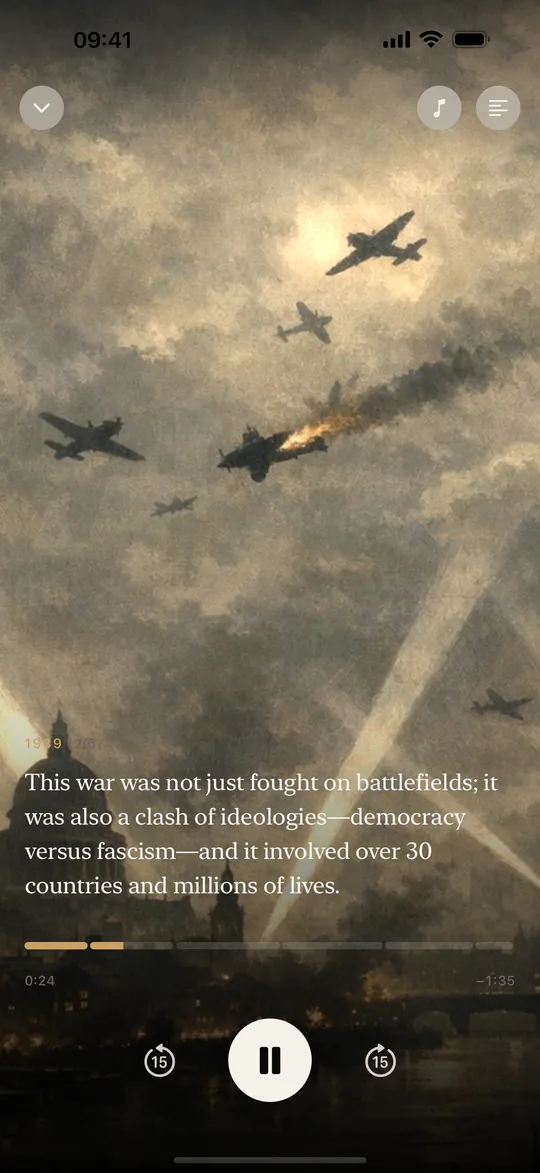
Histia is built for bounded history sessions you can read or listen to. Its public App Store listing advertises short world history stories, daily facts, and quick quizzes. Use one story as a starting point, then follow its subject into longer sources when you want more depth.
Explore a story in HistiaFrequently asked questions
Why is history important in everyday life?
History gives everyday questions a longer timeline. It can show how laws, borders, institutions, technologies, and shared assumptions developed rather than treating them as natural or permanent. That context does not decide what you should think today, but it helps you ask better questions about why the present looks the way it does.
Why should we learn history if the past cannot be changed?
The past cannot be changed, but its consequences remain. Learning history helps us trace how present conditions emerged, examine choices people made under pressure, and see alternatives that once existed. It cannot tell us automatically what to do next; it gives us evidence and context for making a more informed judgment.
Does history really repeat itself?
No historical situation repeats in exactly the same conditions. Comparisons can reveal a useful similarity, but they can also hide differences in institutions, technology, power, culture, and timing. History is best used to generate questions and test analogies, not as a machine that predicts an identical outcome.
How can studying history strengthen critical thinking?
Historical study involves locating evidence, asking who created it and why, comparing accounts, separating observation from inference, and building explanations that remain open to revision. Practising these steps can sharpen evidence-based reasoning in historical questions; it does not automatically make someone better at every kind of thinking.
Why is world history important?
World history makes connections and differences across regions visible. It helps prevent one nation or tradition from standing in for the whole human past, while showing how migration, trade, ideas, disease, technology, and power crossed borders. No single survey can be complete, so its value also depends on whose evidence and perspective are included.
Is history more than memorizing names and dates?
Yes. Names and dates help establish chronology, but historical thinking asks larger questions: what changed, what continued, what caused an outcome, what evidence survives, and which interpretations fit that evidence best. A date is often the starting point for an explanation, not the explanation itself.
Why study history if I do not want a history degree?
You do not need to become a historian to use historical context. It can deepen how you follow current events, understand institutions, visit places, read family records, or question a confident claim about the past. Study can be informal, but the same discipline still matters: ask a clear question, inspect evidence, and remain honest about uncertainty.
Sources and further reading
The sources below support the definitions and practices described here. Claims about what history “does” are kept conditional: studying history involves these habits, but it does not guarantee a personal or political outcome.
- University of Basel, “What Is History?” — definition of history as questioning, analysing, and interpreting sources from the perspective of the present.
- Peter N. Stearns, “Why Study History?” — an archived American Historical Association essay on people, societies, change, identity, citizenship, and historical skills. The AHA labels it as an archival resource that may not reflect its current editorial views.
- Thomas Andrews and Flannery Burke, “What Does It Mean to Think Historically?” — the American Historical Association's five C's: change over time, causality, context, complexity, and contingency.
- The Historical Thinking Project, “Historical Thinking Concepts” — significance, evidence, continuity and change, cause and consequence, perspective, and ethical dimensions.
- Library of Congress, Primary Source Analysis Tool — a practical observe, reflect, question, and investigate-further process.
- Chronicle of the Wall, November 1989 chronology — documents the travel rules, press conference, media reports, crowds, and border-opening sequence used in the worked example.
- Histia: World History Facts — US App Store listing — product category, supported devices, free download with in-app purchases, and advertised story, fact, and quiz features.
Sources and product listing checked September 3, 2026. Spotted an error? Tell us — factual corrections are recorded publicly.