
Learning method
What Is Microlearning? Benefits, Limits and Real Examples
Microlearning is an instructional approach built around a small, focused unit with a specific objective. A useful unit has a clear boundary, enough context to make sense, and a chance to use, recall, or revisit the idea. Shortness alone is not enough. Microlearning can make study easier to schedule, but it cannot replace the depth needed for every subject, and no universal lesson length is proven to be best.

A practical definition of microlearning
A recent systematic review describes microlearning as an instructional approach that delivers targeted, bite-sized content for a specific objective within a short period. The authors also found that the field still lacks one universally accepted definition. That matters: “micro” describes the scale of the learning unit, not a magic number of minutes.
For practical use, look for four parts:
- One specific objective: the learner should know what they are trying to understand or do.
- A bounded unit: it has a clear beginning and end instead of an endless feed.
- Enough context: shortening the lesson should not remove the information needed to understand it.
- A learner action: explain, recall, choose, apply, compare, or revisit the idea.
Text, audio, video, flashcards, diagrams, and quizzes can all carry microlearning. The format matters less than whether the unit is designed to produce a specific learning action.
Short content and microlearning are not the same
| Question | Short content | Microlearning |
|---|---|---|
| Why does it exist? | It may inform, entertain, or hold attention. | It is built around a stated learning objective. |
| What does it include? | It may be an isolated fact, clip, or summary. | It preserves the context needed for one bounded idea. |
| What does the learner do? | The learner may only watch or scroll past. | The design invites recall, use, comparison, or review. |
| What comes next? | There may be no connection to another step. | The unit can stand alone or connect to a larger learning path. |
A sixty-second historical video can therefore be useful short content without being a complete learning unit. Add a clear question, the context needed to answer it, and a recall prompt, and it begins to function as microlearning.
What the evidence suggests — and what it does not
A systematic review analyzed 40 peer-reviewed studies published between 2020 and 2024. It reported positive cognitive, behavioural, and affective outcomes across the included studies. But the formats, populations, subjects, and measurements varied, and much of the reviewed research came from medical and healthcare settings. The review supports treating microlearning as a promising instructional approach, not as a universal guarantee.
Two related findings are useful when designing a microlearning routine:
- Spacing: a large quantitative synthesis covered 839 assessments in 317 experiments. It found that the interval between study sessions and the delay before the final test work together. It does not provide one perfect review interval for every goal.
- Retrieval: in two experiments using prose passages, repeated study produced better recall on a test after five minutes, while prior testing produced better retention after two days or one week. The result supports attempting recall when later retention matters, under those tested conditions.
Neither finding proves that a five-minute lesson is optimal. Duration, spacing, content difficulty, prior knowledge, and the kind of test all matter.
Benefits of well-designed microlearning
It makes the next step clear
“Learn the Roman Empire” is too broad for one session. “Explain two pressures on the western empire in the fifth century” gives the learner a visible finish line. A smaller objective can make it easier to begin and easier to check what was understood.
It can fit into ordinary gaps
A bounded unit can fit a commute, break, or quiet moment more easily than an open-ended chapter. That is a scheduling benefit, not proof that the unit will be remembered. The learning design still matters.
It is easier to revisit
A focused unit can be reopened without repeating a full course. That makes it compatible with distributed practice, provided the learner actually returns and tries to retrieve the idea.
It can build toward a larger subject
Small units do not have to mean disconnected facts. A sequence on the French Revolution might move from the fiscal crisis to the Estates-General, the Bastille, political factions, war, and the Terror. Each unit stays bounded while the series preserves the wider chain.
The limits: when smaller is not better
- Complexity can be stripped away. Some subjects need a sustained argument, several sources, or time to compare interpretations.
- Fragments can hide relationships. A collection of memorable facts is not the same as understanding chronology, cause, and consequence.
- Familiarity can feel like mastery. Recognizing a screen or rereading a summary does not show that you can recall or apply the idea later.
- A feed can stay a feed. Short educational posts become another form of scrolling when they lack boundaries, reflection, and a meaningful path.
- One format will not fit every learner or task. Audio may suit a walk; a map, primary document, or long text may be better when close inspection matters.
Use microlearning as an entry point, practice layer, or review tool. For depth, combine it with books, lectures, long articles, museum collections, primary sources, or formal instruction.
Real examples across different subjects
| Subject | Bounded objective | Learner action |
|---|---|---|
| History | Explain why the printing press made repeatable pages easier to distribute. | Recall two enabling changes and one consequence, then check the explanation. |
| Language | Use one phrase to order food politely. | Choose the phrase in a scenario, then say it without looking. |
| Workplace safety | Identify the first three actions after one defined incident. | Put the actions in order and explain the first decision. |
| Science | Explain why Earth's seasons are not caused by distance from the Sun. | Select the correct diagram and explain the role of axial tilt. |
For a complete history example, read how the printing press changed the world, close the page, and try to name the mechanism and two consequences before checking your answer.
A simple method: bounded unit → recall → review
This three-step method is a practical synthesis, not a named scientific law:
- Bounded unit: choose one question and stop when you can answer it with the essential context intact.
- Recall: close the material and explain the answer from memory. Use a quiz or write two to three points if that helps.
- Review: return later, attempt the answer again, and correct what was missing. The interval should serve your goal; there is no universal schedule.
This is also why a history quiz is most useful when it checks a meaningful story or idea rather than rewarding recognition alone. For more detail, see the guide to remembering history facts and dates.
What this can look like in Histia
Histia is one implementation of short, story-based history learning. Its public App Store listing describes short world history stories, daily facts, quick quiz rounds, streak-friendly sessions, and saved favourites. A learner can use one story as the bounded unit, attempt the quiz where one appears, and return to the topic later. This does not make every session an automatic spaced-review program, and it does not prove a learning outcome.
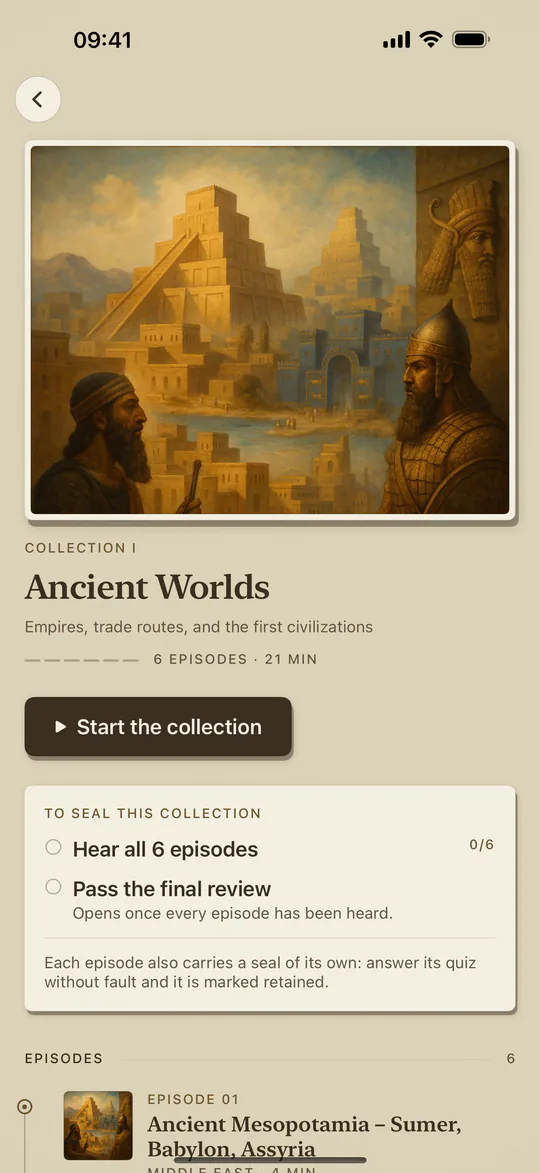
Try the loop with one history story
Histia is free to download for iPhone and iPad running iOS or iPadOS 18 or later, with optional in-app purchases. Start with one bounded story, then test what you remember.
Try one story in HistiaRun a 7-day microlearning experiment
This is a personal test, not a scientifically optimal schedule. Keep the topic narrow enough to judge honestly at the end.
- Day 1: choose one historical question. Learn one bounded unit, close it, and write three points from memory.
- Day 2: answer yesterday's question without notes. Correct only the gaps you find.
- Day 3: learn a related unit and write one connection between the two.
- Day 4: retrieve the first answer again, this time focusing on cause and consequence.
- Day 5: use a different format — read if you listened, or listen if you read — then recall the same core idea.
- Day 6: explain the sequence aloud without looking. Mark any point you cannot support.
- Day 7: write a no-notes summary, check it against your sources, and decide whether the method improved completion and recall for you.
If five minutes fits your routine, the five-minute history guide provides a simple habit structure. Treat the duration as a practical boundary, not a universal optimum.
Frequently asked questions
What is microlearning in simple terms?
Microlearning is an instructional approach built around a small, focused learning unit with a specific objective. A useful unit has a clear boundary, enough context to make sense, and an opportunity to use, recall, or revisit the idea. It may use text, audio, video, a quiz, or a combination of formats.
Is microlearning just short content?
No. A short clip or isolated fact can be brief without being designed for learning. Microlearning connects the content to a learning objective and gives the learner a way to do something with it, such as explain an idea, answer a question, make a decision, or review it later.
How long should a microlearning lesson be?
There is no universal optimal length. The lesson should be long enough to meet one specific objective without removing essential context. Some units take seconds and others take several minutes. Five minutes is a convenient product format, not a scientifically established rule for every subject or learner.
Does microlearning improve memory?
It can support memory when the design includes useful material, active recall, and later review, but shortness alone does not guarantee retention. Research on retrieval practice and distributed practice supports those techniques under tested conditions. It does not prove that every short lesson or microlearning app will produce the same result.
Can microlearning replace books or courses?
Usually not. Microlearning is useful for introductions, practice, review, and one clearly bounded skill or idea. Books, courses, long articles, and seminars are better when you need sustained argument, multiple perspectives, detailed evidence, or guided practice across a complex subject.
What is a microlearning example for history?
A history unit might answer one question, such as why the printing press changed the spread of information. It would provide the necessary people, sequence, and context, then ask the learner to recall two causes and one consequence before checking the answer and reviewing the idea later.
Research and product sources
The research supports specific design choices under tested conditions. It does not establish one ideal lesson length or guarantee results from a particular product.
- Monib, Qazi and Apong, “Microlearning beyond boundaries: A systematic review and a novel framework for improving learning outcomes” — systematic review of 40 studies and source for the definition, reported outcomes, study mix, and limitations.
- Cepeda et al. (2006), “Distributed practice in verbal recall tasks: A review and quantitative synthesis” — quantitative synthesis of spacing and retention intervals.
- Roediger and Karpicke (2006), “Test-Enhanced Learning: Taking Memory Tests Improves Long-Term Retention” — two prose-passage experiments comparing testing and repeated study.
- Histia: World History Facts — US App Store listing — product features, supported devices, minimum operating system, free download, and in-app purchases.
Sources and product listing checked August 25, 2026. Spotted an error? Tell us — factual corrections are recorded publicly.