
Audio learning guide
Audio history stories: how to learn by listening
Audio learning can make history available when looking at a page is impractical, such as on a walk or train commute. It is not automatically better than reading. A meta-analysis found no reliable overall comprehension difference, while self-paced reading performed better in some conditions. Choose the format for the task, then use a simple loop: listen, recall the main idea without looking, and verify it against text and sources.
What audio learning for history means
Audio learning means using spoken material to understand or review a subject. For history, that material might be a podcast conversation, an audiobook chapter, a recorded lecture, or one short narrated story. The audio format does not make a claim reliable: dates, quotations, causes, and disputed interpretations still need sources.
A short recording can be a useful first pass when your eyes are busy. It cannot carry the same depth as a book chapter, and “short” is not a learning result by itself. A five-minute story may help you begin a topic; it does not prove that five minutes is the ideal duration for memory.

Listening versus reading: neither wins every time
A 2022 meta-analysis compared reading and listening comprehension across 46 studies and 4,687 participants. It found no reliable overall difference between the two formats. Reading did better when readers controlled their own pace and when tests asked for inferential or general comprehension rather than literal details. The studies covered different ages and materials; they were not a test of Histia or of history learning alone.
That makes the practical choice simpler:
- Use audio when looking at a screen is inconvenient and the material can be followed safely by ear.
- Use text when you need to inspect names and dates, compare passages, study a map, follow citations, or stop and reread a difficult argument.
- Use both when the text helps you locate or check a passage, not because two formats automatically produce twice the learning.
Does reading while listening help?
Sometimes, but the result depends on the setting. A 2023 meta-analysis covering 30 studies and 1,945 participants found a small overall comprehension benefit for reading while listening compared with reading alone. That benefit was not reliable when people could read at their own pace. The review also said there were too few studies to make broad claims for struggling readers or second-language learners.
Synced text can still have practical value: it can show how a name is written, make a passage easier to find, and give you another way to follow the story. Those are useful controls, not proof that the combined mode is always better.
What the evidence does not show
These studies do not show that audio is superior, that every learner responds in the same way, or that a five-minute session is optimal. They also do not compare individual history apps. The safest conclusion is to choose a format that fits the task, then check what you actually understood and remembered.
Podcast, audiobook, or five-minute narrated story?
The right format depends on the question and the time available. A short story is not a compressed audiobook, and a podcast is not automatically a lesson.
| Format | Best fit | Main trade-off |
|---|---|---|
| History podcast | Interviews, discussion, serialized narratives, and hearing historians reason through a subject. | Length and structure vary. A conversational episode can be harder to scan later for one fact. |
| History audiobook | A sustained account or argument developed across chapters. | It asks for a longer commitment, and exact references may be easier to inspect in the written edition. |
| Five-minute narrated story | A first look at one person, event, or question in a predictable short window. | The format limits depth. Follow it with a longer source when context or disagreement matters. |
Use the listen → recall → verify loop
- Listen: choose one narrow topic and listen once. If you are driving, set it up before moving and do not handle the phone on the road.
- Recall: once you are safely stopped, state the main event, two supporting details, and one point you are unsure about without opening the text.
- Verify: open the transcript or a reliable written source. Check names, dates, causes, and your uncertain point.
- Correct: replace any error with a short, accurate explanation in your own words. If the subject is contested, record the disagreement instead of forcing one answer.
The recall step is informed by retrieval-practice research. In two experiments with prose passages, immediate free-recall tests led to better delayed retention than repeated study under the tested conditions. The experiment was not about audio, commuting, or Histia, so it supports trying recall without proving that this exact routine will work for everyone.
How Histia can support the routine
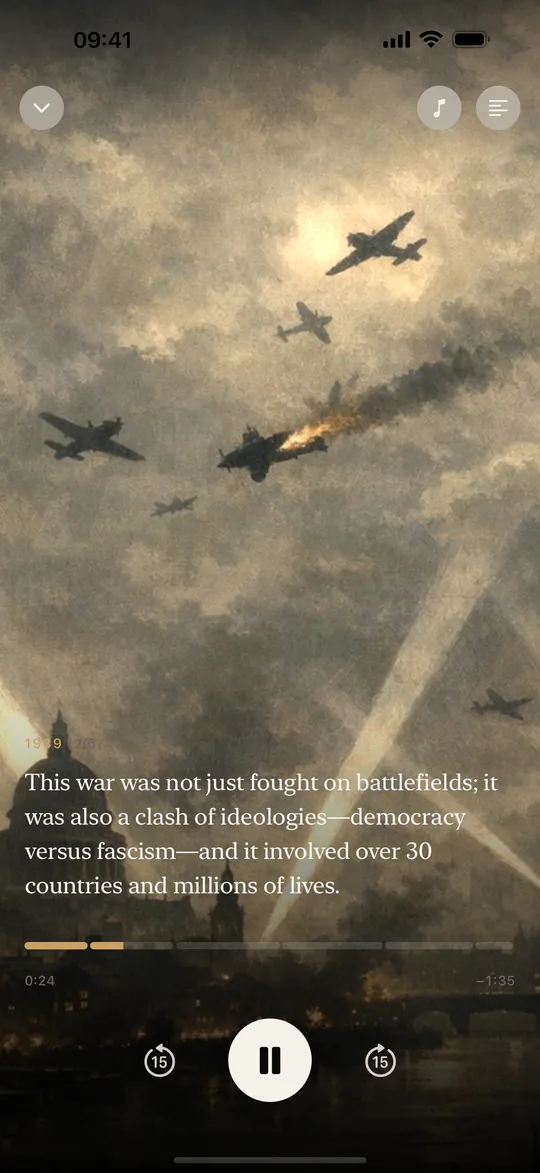
Histia is one way to put the method into practice, not evidence that it works better than other formats. When a published story includes narration, the current player shows timed text with the audio and provides 15-second skip controls. A full transcript can be used to find a passage, and playback position can be saved so you can resume later. These controls were checked against the current app implementation on August 25, 2026; the interface and available stories can change.
Try the loop with one narrated story
Listen once, recall what happened, then use the text to check yourself. Histia is free to download; the App Store lists optional in-app purchases.
Try the routine in HistiaA realistic commute routine
- Before leaving: choose one episode or chapter and decide the single question you want it to answer.
- During the journey: listen without trying to capture every date. Follow the people, sequence, and outcome.
- At your destination: once it is safe to do so, give a one-sentence summary from memory.
- Later: use text and sources to check two details. For a topic you want to understand deeply, continue with a book, primary source, museum, archive, or academic work.
When text should take the lead
Switch to text when the task depends on precise wording, a table, a map, a footnote, or comparison between sources. Reading is also a better fit when you need to control the pace of a difficult argument. Audio can introduce the question; it should not be your only evidence for a quotation, a disputed cause, or a number you plan to repeat as fact.
Frequently asked questions
Is listening to history as effective as reading?
Not in every situation. A meta-analysis of 46 studies found no reliable overall comprehension difference. Self-paced reading had an advantage in some conditions, including tests of inferential and general comprehension. The best choice depends on the material, your control over the pace, and the attention available.
Should I read while listening?
Not always. A 2023 meta-analysis found a small overall benefit for reading while listening, but no reliable benefit when reading was self-paced. Synced text can still be useful for accessibility, checking names, or finding a passage, without guaranteeing better comprehension.
How can I remember history after listening?
After listening, state the main event, two supporting details, and one uncertainty without looking. Then check the transcript and reliable sources and correct any error. Retrieval-practice research supports testing memory under specific study conditions, but it does not prove that this exact audio routine works for everyone.
Research and product sources
- Clinton-Lisell (2022), Listening Ears or Reading Eyes — meta-analysis of reading and listening comprehension comparisons.
- Clinton-Lisell (2023), Does Reading while Listening to Text Improve Comprehension Compared to Reading Only? — systematic review and meta-analysis.
- Roediger and Karpicke (2006), Test-Enhanced Learning — two experiments comparing free-recall testing with repeated study of prose passages.
- Apple App Store, Histia: World History Facts — platform, compatibility, free download, and optional in-app purchases; checked August 25, 2026.
Research links and product details were checked on August 25, 2026. Spotted an error? Tell us — corrections are logged and the update date above is revised.
Listen to one short history story on your next commute
- Choose a story before leaving and check that it has narration. Pick a duration that fits the train ride or the part of your break available for listening.
- Open the player in Histia and start the narration. Use the synchronized text when you want to check an unfamiliar name or place.
- If you lose the thread, replay the passage instead of adding another episode. When the story ends, describe the main event in a sentence.
- Later, reopen the story or follow a related theme. Check an external source for a claim you want to study more closely.
This is a short narrated-story routine. Full offline access, background playback, and podcast subscriptions should not be assumed from the presence of an audio player; check the current app experience for the setup you need.
Get Histia for narrated history stories
Free to download · Optional in-app purchases · iPhone & iPad · iOS 18+