Soviet Union · 1985–1991
Why did the Soviet Union collapse? The long crisis and final five months
Short answer: The Soviet Union collapsed because long economic stagnation, shortages, and declining trust met reforms that weakened central control without quickly fixing the economy. Glasnost exposed past failures; elections and republican movements created new centers of power; and Gorbachev and Yeltsin competed over authority. The failed August 1991 coup accelerated independence, and republic leaders dissolved the union in December.

What you’ll understand in 8 minutes
- the difference between long-term weakness and the events that decided the final timing;
- why reforms could open the system faster than they repaired it;
- how the failed coup and decisions by Soviet republics ended the union in 1991.
Remember the chain: stagnation weakened trust; reform weakened control; republics built alternatives; the coup destroyed the center.
Collapse was a process, not a single cause
The USSR did not disappear simply because one policy failed or one foreign leader applied pressure. Structural problems made the system vulnerable. Political choices changed who held power. The failed coup and republic agreements determined when and how the state ended. Separating those layers prevents a neat but false one-cause story.
Cause 1 A slow economic crisis eroded confidence
By the early 1980s, Soviet growth had slowed. Central planning could still mobilize enormous resources, but it struggled with productivity, quality, innovation, and consumer supply. Shortages and informal workarounds became part of daily life.
Economic weakness did not automatically require the country to break apart. It did make promises of abundance less credible and left reformers trying to change a huge system under pressure.
Cause 2 Perestroika disrupted before it delivered
After becoming general secretary in 1985, Mikhail Gorbachev introduced perestroika—restructuring—to revive the economy. The reforms mixed market-like changes with surviving planning controls. Old mechanisms weakened before new ones worked reliably, contributing to confusion and worsening shortages.
This is a reform dilemma, not proof that change itself was a mistake: Gorbachev was responding to problems that already existed, but partial reform brought few immediate material rewards.
Cause 3 Glasnost changed what people could challenge
Glasnost expanded public discussion. Censorship eased, past crimes and current failures received wider attention, and citizens could compare official claims with lived experience. Political reforms and competitive elections created new platforms outside the old Communist Party hierarchy.
Openness did not invent every grievance. It made grievances visible, connected critics, and reduced the center’s power to define one acceptable account of the past or present.
Cause 4 Republics became rival centers of sovereignty
The Soviet Union was a federation of republics with borders, institutions, and national identities. As central authority loosened, movements in the Baltic republics, Caucasus, Ukraine, and elsewhere demanded sovereignty or independence. Republican leaders gained elected legitimacy and control over local institutions.
Russia itself became part of the struggle. Boris Yeltsin, leading the Russian republic, competed with Gorbachev, who led the union. The center was therefore challenged not only at the edges but from its largest republic.
Cause 5 The August coup destroyed what authority remained
Hard-line officials attempted to remove Gorbachev on August 19, 1991, just before a new union treaty was due to be signed. Tanks entered Moscow. The plotters failed to secure obedience or public legitimacy; resistance centered around the Russian parliament, where Yeltsin emerged as the visible opponent of the coup.
The coup collapsed by August 21. Instead of restoring the union, it discredited the central institutions involved, strengthened Yeltsin, and accelerated declarations of independence. It did not create every cause, but it sealed the political center’s loss of power.
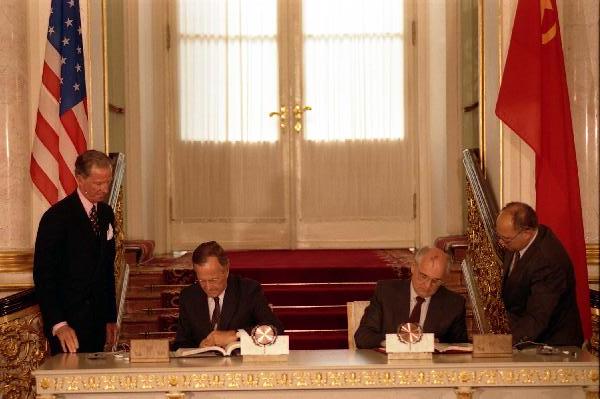
The final five months: crisis becomes dissolution
March 17, 1991
A renewed union still had support
In participating republics, 76.43% of voters backed a renewed federation. Several republics did not participate. The result shows that the ending was not yet universally settled.
August 19–21
The coup fails
Hard-liners detain Gorbachev and declare emergency rule. Resistance and institutional defection defeat the attempt within three days.
August–December
Independence accelerates
Republics declare or confirm independence. Ukraine’s December vote makes a union without its second-largest republic politically unworkable.
December 8
Three republic leaders act
The leaders of Russia, Ukraine, and Belarus declare that the USSR has ceased to exist and announce the Commonwealth of Independent States.
December 21
More republics join the new framework
Eleven republics endorse the Alma-Ata arrangements, leaving Gorbachev at the head of a union with no workable federation beneath it.
December 25–26
The state formally ends
Gorbachev resigns on December 25. The next day, the Soviet of the Republics formally recognizes the USSR’s dissolution.
Was collapse inevitable?
No source can prove inevitability. A declassified 1985 US intelligence estimate described stagnation and serious social problems but did not predict imminent disintegration. In March 1991, many participants still voted for a renewed union rather than immediate breakup. Both facts warn against treating the end as obvious in advance.
At the same time, by late 1991 the range of workable alternatives had narrowed sharply. Economic crisis, competing sovereignties, and the coup had made a stable recentralization far less plausible. History can be contingent without being random.
Myth vs evidence
Myth
One leader “won” the Cold War
External pressure mattered, but the mechanism of breakup ran through Soviet reforms, republican institutions, elections, elite conflict, and the failed coup.
Evidence
Domestic politics set the timing
Republic leaders withdrew authority from the center and negotiated the replacement framework after the coup shattered central credibility.
Myth
Gorbachev simply chose to abolish the USSR
He sought a reformed union. By December, other republic leaders had reached agreements that left his office without an effective state.
Evidence limit
No single cause passes the test
The economy explains weakness, reforms explain changing rules, nationalism explains alternatives, and the coup helps explain the final acceleration.
Three takeaways
- Weakness and breakup are different: stagnation created pressure, but political institutions turned pressure into disintegration.
- Reform had two effects: it tried to save the system while opening space for forces the center could no longer control.
- 1991 decided the timing: the failed coup, republic independence, and December agreements ended the remaining union.
Check what you remember
Why didn’t economic stagnation automatically mean breakup?
States can survive poor performance. Breakup required political alternatives: stronger republic institutions, leaders claiming sovereignty, and a central authority unable to enforce or renegotiate the union.
How could reform both help and weaken the USSR?
Reform addressed real problems, but partial economic change disrupted old controls while openness and elections gave critics and republic leaders new ways to organize.
Why was the August coup a turning point?
Its failure discredited the union center and Communist Party, strengthened Yeltsin, and accelerated republic moves toward independence.
Frequently asked questions
When did the Soviet Union officially end?
Mikhail Gorbachev resigned on December 25, 1991. On December 26, the Soviet of the Republics formally recognized the dissolution of the USSR. The breakup had already been decided through republic declarations and agreements earlier that month.
Did the Soviet economy alone cause the collapse?
No. Economic stagnation and shortages undermined the system, but political reform, declining legitimacy, nationalist and sovereignty movements, competition between union and republican leaders, and the failed August coup determined how the crisis became a breakup.
Did Ronald Reagan cause the Soviet Union to collapse?
US pressure and the wider arms burden formed part of the context, but one foreign leader does not explain the domestic mechanisms of collapse. Economic weakness, reforms, republican power, and Soviet political decisions were central to the timing and form of the breakup.
Sources and how to read them
- US Office of the Historian — The collapse of the Soviet Union, for the coup and December 1991 sequence.
- Foreign Relations of the United States — 1985 intelligence assessment, a contemporary record of what analysts saw—and failed to predict.
- Library of Congress — Soviet Union: A Country Study, for perestroika, glasnost, the economy, and the federation’s disintegration.
- Archie Brown, “The collapse of the Soviet Union, 1990–1991,” Cambridge History of the Cold War, for domestic political mechanisms.
- Boris Yeltsin Presidential Library — March 1991 referendum, for the result and participating-republic limitation.
- National Security Archive — The end of the Soviet Union, 1991, with declassified documents and chronology.
- World History Commons — Gorbachev’s resignation speech, for his own explanation and position on a renewed union.
Checked August 24, 2026. Contemporary documents show what actors knew at the time; later scholarship helps explain causes with hindsight.
Spotted an error? Tell us — factual corrections are recorded publicly.
Rather listen?
Make history a five-minute habit.
Histia turns moments like this into short narrated stories, free for iPhone and iPad.
- Listen, read, or watch in cinematic mode
- Quick quizzes to make it stick
- A map of history from 3000 BCE to 2025

Free to download · Optional in-app purchases · iOS 18+