
Space Race · 20 July 1969
Did We Really Land on the Moon?
Yes — overwhelming, independently verifiable evidence confirms the Apollo Moon landings happened. Beyond the footage, astronauts left retroreflector mirrors still used by scientists today to bounce lasers off the Moon and measure its distance to the millimeter. The landing was also tracked in real time by the Soviet Union — America's Cold War rival, which had every incentive to expose a hoax and never did. Every popular "proof" of fakery (the flag, the shadows, no stars) has a well-documented physical explanation.
Key facts
- Apollo 11 landed with less than 30 seconds of fuel remaining after Neil Armstrong manually steered past a boulder field — one of the closest calls in the whole program.
- Retroreflectors placed on the surface in 1969, 1971, and 1972 are still hit with lasers by observatories today, pinning the Moon's distance to within a few millimeters — a hoax cannot leave a permanently checkable mirror behind.
- The Soviet Union — locked in the actual Space Race — tracked Apollo 11 independently with its own deep-space antennas and never disputed the landing, despite having the strongest motive on Earth to do so.
- Three later Apollo missions carried a Lunar Roving Vehicle that covered over 27 km of surface across Apollo 15, 16, and 17 — footage impossible to fake convincingly with 1969-1972 technology.
- The flag appeared to "wave" only because it had a horizontal rod sewn into the top edge to hold it out in the airless vacuum — it visibly stops moving seconds after being planted.
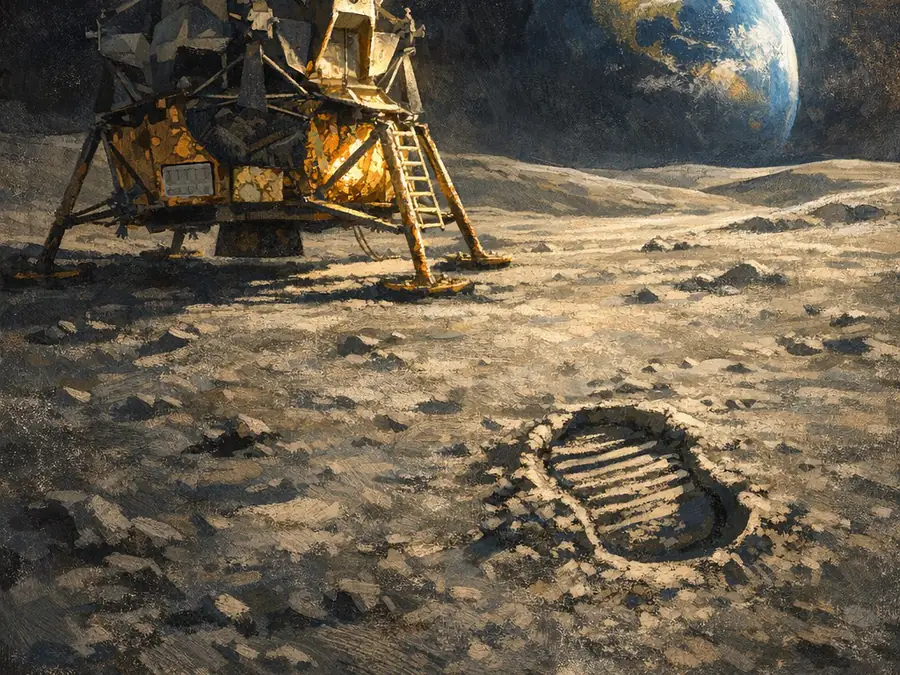
- India's Chandrayaan-2 orbiter photographed the Apollo landing sites from lunar orbit in 2019, and NASA's Lunar Reconnaissance Orbiter has imaged descent stages, rover tracks, and even astronaut footpaths at all six sites.
Why the doubt exists in the first place
Moon-landing skepticism isn't irrational curiosity — it's a byproduct of a genuinely paranoid decade. The late 1960s and 1970s gave Americans Watergate, the Pentagon Papers, and a government that had lied about Vietnam for years. A 1976 self-published pamphlet by Bill Kaysing, a former Rocketdyne technical writer with no aerospace engineering background, planted the first seeds; a 2001 Fox TV special ("Conspiracy Theory: Did We Land on the Moon?") supercharged them for a new generation raised on grainy YouTube clips instead of raw NASA telemetry. The theory persists less because the physics is ambiguous and more because distrust of institutions is comfortable, contagious, and immune to new evidence.
The flag, the shadows, the stars — debunked one by one
Every viral "gotcha" image has an answer that takes less time to understand than to Google. The flag "waves": it has a horizontal rod along the top so it would display properly in a vacuum with zero wind — watch any full clip and it stops moving within seconds, exactly as a stiff fabric on a rod should. Shadows point different directions: on uneven lunar terrain, parallel light sources cast shadows that appear to diverge due to perspective and slope — the identical effect happens in any photo with hills, including on Earth. No stars in the photos: the lunar surface in sunlight is blindingly bright; astronaut cameras were set for that exposure, the same reason you can't see stars in a daytime photo on Earth, or in a photo of a lit stage. The Van Allen radiation belts: Apollo's trajectory was deliberately plotted to cross the thinnest regions quickly, and the transit time (under two hours through the belts) kept exposure within safety margins that Apollo-era engineers calculated and later dosimetry confirmed.
The evidence a hoax literally cannot fake
Physical props and camera tricks can't explain everything NASA left behind. Apollo 11, 14, and 15 planted retroreflector arrays — arrangements of corner-cube mirrors that reflect a laser beam straight back to its source. Observatories from McDonald in Texas to Côte d'Azur in France still fire lasers at them decades later as part of ongoing lunar-distance research, and amateur astronomers have replicated the measurement. No hoax can plant a mirror on a body 384,000 km away using 1960s remote technology — someone had to physically place it there.
Then there's the independent confirmation nobody controlled by NASA could fabricate. The Soviet Union tracked the mission with its own deep-space network at the height of the Cold War and said nothing to contradict it — a superpower desperate for propaganda wins passing up the single greatest one available. Decades later, orbital photography from multiple countries — the American LRO, and India's Chandrayaan-2 — has independently imaged the landing sites, descent stages, and even rover tire tracks from lunar orbit.
What actually happened on July 20, 1969
Strip away the noise and the real story is more astonishing than any conspiracy. Six months after Apollo 8 first orbited the Moon, Apollo 11's lunar module Eagle began its automated descent with a computer overloaded with alarm codes (1202, 1201) that mission control had to clear in real time. Fuel ran critically low as Armstrong, seeing the autopilot heading for a boulder-strewn crater, took manual control and searched for flat ground — touching down with an estimated 25 to 45 seconds of fuel left, one of the tightest margins in the program's history.
"The Eagle has landed," Armstrong radioed, and six and a half hours later stepped onto the surface: "That's one small step for man, one giant leap for mankind." He and Buzz Aldrin spent about two and a half hours outside, collecting 21.5 kg of lunar samples still studied today, while Michael Collins orbited alone overhead — famously more isolated from other humans than anyone before him. It remains, on the actual documentary record, the most thoroughly verified engineering achievement of the 20th century.
Frequently asked questions
What is the strongest single piece of proof we landed on the Moon?
The retroreflector mirrors astronauts placed on the surface, which scientists worldwide still use today to bounce lasers off the Moon for precision distance measurements. A hoax could fake photographs; it cannot plant a physical, remotely-verifiable instrument on another world.
Why didn't the Soviet Union expose the Moon landing as fake if it was one?
The USSR tracked Apollo 11 in real time with its own independent deep-space tracking stations, as part of the actual Space Race rivalry. Exposing a fabricated landing would have been the single greatest propaganda victory of the Cold War — and it never happened, because there was nothing to expose.
How many times have humans landed on the Moon?
Six times, all part of NASA's Apollo program: Apollo 11, 12, 14, 15, 16, and 17, between July 1969 and December 1972. Twelve astronauts walked on the surface in total; no human has returned since Apollo 17 in 1972.
Sources & further reading
This article was written from the published record. Every link below was checked and is live:
- NASA — Apollo 11 mission overview
- NASA — NASA History
- NASA Science — Lunar Reconnaissance Orbiter
- Wikipedia — Apollo 11
- Wikipedia — Lunar Laser Ranging experiments
Spotted an error? Tell us — corrections are logged and the update date above is revised.
Rather listen?
Hear “Moon Landing (1969)” as a five-minute story.
It is a narrated story in Histia, the free history app for iPhone and iPad.
- Listen, read, or watch in cinematic mode
- A quick quiz to lock it in
- A map of history from 3000 BCE to 2025

Free to download · Optional in-app purchases · iOS 18+