South Africa · 1962–1990
How Long Was Nelson Mandela in Prison?
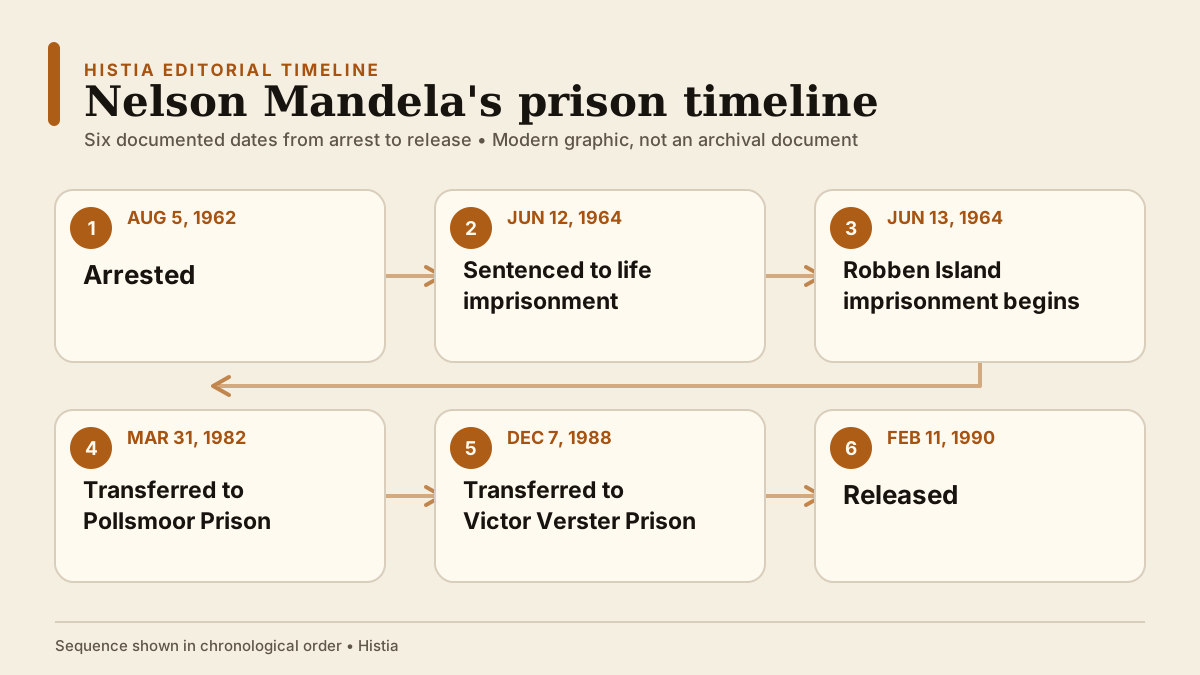
Nelson Mandela spent 27 years in prison — from his arrest in August 1962 to his release on 11 February 1990 — the majority of it (18 years) on the notorious Robben Island. He was convicted in 1964 of sabotage and conspiracy to overthrow the apartheid government, after co-founding the armed wing of the African National Congress. He emerged at 71 not embittered but strategically conciliatory, and was elected South Africa's first Black president just four years later, in 1994.
Key facts
- Mandela was originally sentenced to just 5 years in 1962 for incitement and leaving the country illegally — a separate, later trial (the Rivonia Trial, 1963-64) added a life sentence for sabotage.
- At the Rivonia Trial, facing a possible death sentence, Mandela's courtroom speech ended with the line: "It is an ideal for which I am prepared to die." He was sentenced to life instead.
- On Robben Island, political prisoners were forced to do hard labor breaking rocks in a limestone quarry — the glare permanently damaged Mandela's eyesight, and he could no longer be photographed with flash later in life.
- Prisoners were classified by race for privileges under apartheid rules even inside prison; Mandela, classified lowest-tier, was permitted one visitor and one letter every six months in his early years of incarceration.
- He earned a law degree by correspondence while imprisoned, part of what fellow inmates later called "Mandela University" — informal, prisoner-run education and political debate that continued for decades behind bars.
- He was offered conditional release multiple times starting in the 1980s if he renounced armed struggle — he refused every offer, having his daughter read his public refusal aloud at a stadium rally in 1985 because he was barred from being quoted directly in South African media.
From lawyer to armed resistance
Mandela did not start as a militant. Trained as a lawyer, he co-founded South Africa's first Black-run law firm in 1952 and rose through the African National Congress advocating nonviolent resistance to apartheid — the legally enforced system of racial segregation entrenching white minority rule. That changed after the Sharpeville massacre of 1960, in which police killed 69 unarmed Black protesters, and the subsequent government ban on the ANC itself. Concluding that peaceful protest could no longer function against a state willing to shoot unarmed demonstrators and outlaw dissent outright, Mandela co-founded Umkhonto we Sizwe ("Spear of the Nation"), the ANC's armed wing, in 1961 — targeting infrastructure and government installations while explicitly trying to avoid civilian casualties.
Arrest, Rivonia, and a life sentence
Mandela was arrested in August 1962, reportedly after a tip to police (some accounts implicate CIA involvement, still debated by historians), and initially convicted in November 1962 of incitement and leaving the country without a passport — a five-year sentence. While already imprisoned, police raided the ANC's secret headquarters at a farm in Rivonia and seized documents implicating him and other leaders in planning armed sabotage. The resulting Rivonia Trial (1963–64) could have ended in execution.
Mandela's nearly four-hour speech from the dock became one of the 20th century's defining political statements, closing with the words: "I have cherished the ideal of a democratic and free society... It is an ideal which I hope to live for and to achieve. But if needs be, it is an ideal for which I am prepared to die." He and seven co-defendants were sentenced to life imprisonment rather than death in June 1964.
Eighteen years on Robben Island
Mandela spent the next 18 years on Robben Island, a windswept penal colony off Cape Town reserved largely for political prisoners. Conditions were deliberately harsh and racially graded even within the prison: Black inmates received smaller food rations and fewer privileges than other racial classifications under apartheid law. Prisoners performed forced labor breaking limestone in a quarry — work that permanently damaged Mandela's eyes from years of glare, and left him with a lifelong lung condition from the dust and a cold, damp cell.
Yet the island also became, in the words of prisoners themselves, "Mandela University" — inmates ran clandestine political education, and Mandela himself completed a law degree via correspondence during his sentence. He was transferred to Pollsmoor Prison in 1982 and later to Victor Verster Prison in 1988, as the apartheid government, under mounting international sanctions and domestic unrest, began quietly testing the waters for negotiation.
The offers he refused, and the walk to freedom
By the mid-1980s, with South Africa increasingly isolated by international sanctions and rocked by internal uprising, the government offered Mandela conditional freedom multiple times if he would renounce armed struggle. He refused every time. In 1985, barred from being directly quoted in South African media, he had his daughter Zindzi read his response aloud to a packed stadium: "What freedom am I being offered while the organization of the people remains banned? Only free men can negotiate. Prisoners cannot enter into contracts."
Negotiations finally began in earnest after F.W. de Klerk became president in 1989 and unbanned the ANC. On 11 February 1990, Mandela walked out of Victor Verster Prison at 71 years old, watched by a global television audience, having served 27 years. Remarkably, he emerged advocating reconciliation rather than retribution, working with de Klerk (with whom he shared the 1993 Nobel Peace Prize) to dismantle apartheid through negotiation rather than civil war. In April 1994, in South Africa's first fully democratic election, he was elected the country's first Black president — just over four years after leaving his cell.
Frequently asked questions
How many years total did Nelson Mandela spend in prison?
27 years, from his arrest in August 1962 until his release on 11 February 1990. Of those, 18 years were served at Robben Island prison off Cape Town, with the remainder at Pollsmoor and Victor Verster prisons.
What crime was Nelson Mandela actually convicted of?
At the 1963-64 Rivonia Trial, he was convicted of sabotage and conspiracy to violently overthrow the government, tied to his role co-founding Umkhonto we Sizwe, the armed wing of the African National Congress. He faced a possible death sentence and received life imprisonment instead.
Why did Mandela refuse offers of early release?
Because they came with a condition — renouncing armed struggle — while the ANC remained a banned organization and apartheid remained fully in force. He argued that a prisoner without freedom to organize politically couldn't meaningfully negotiate, and held out until the government agreed to unban the ANC and begin real negotiations in 1990.
Which prisons was Nelson Mandela held in?
After his 1962 arrest he was held in Pretoria, with a brief spell on Robben Island in 1963. After the Rivonia Trial he spent about 18 years on Robben Island (1964–1982), about six years at Pollsmoor Prison in Cape Town (1982–1988), and his final 14 months at Victor Verster Prison near Paarl, where he lived in a warder's house until his release in February 1990.
Why was Nelson Mandela first sent to prison?
In November 1962 he was sentenced to five years for inciting workers to strike and for leaving South Africa without a passport. He was already serving that sentence when the police raid on Rivonia led to a second trial and, in June 1964, a life sentence for sabotage.
How old was Nelson Mandela when he was released?
71. He was born on 18 July 1918, arrested at 44 in August 1962, and walked out of Victor Verster Prison on 11 February 1990.
What was Nelson Mandela's prisoner number?
46664. It meant he was the 466th prisoner admitted to Robben Island in 1964. After his release the number became the name of his HIV/AIDS awareness campaign.
Sources & further reading
This article was written from the published record. Every link below was checked and is live:
- Nelson Mandela Foundation — Prison timeline
- Nelson Mandela Foundation — Trials and prison chronology
- The Nobel Prize — Nelson Mandela – Facts (Peace 1993)
- Nelson Mandela Foundation — Official archive
- Wikipedia — Nelson Mandela
- Wikipedia — Rivonia Trial
- Wikipedia — Robben Island
Spotted an error? Tell us — corrections are logged and the update date above is revised.
Rather listen?
Hear “Nelson Mandela” as a five-minute story.
It is a narrated story in Histia, the free history app for iPhone and iPad.
- Listen, read, or watch in cinematic mode
- Read along with the narration
- A map of history from 3000 BCE to 2025

Free to download · Optional in-app purchases · iOS 18+