
Tudor England · 1536
Why was Anne Boleyn executed?
The legal answer: Anne Boleyn was convicted of high treason after being accused of adultery with several men, incest with her brother George, and plotting or imagining Henry VIII's death. The historical answer is less certain: the case developed after Anne failed to provide a surviving son, Henry turned toward Jane Seymour, and Thomas Cromwell organized the prosecution. The records prove the charges and verdict existed; they do not prove the accusations were true.
Documented record What happened in May 1536
Anne was arrested on May 2 and taken to the Tower of London. Men accused alongside her had already been tried before Anne and her brother appeared before a court of peers. The surviving King's Bench material preserves the indictments, writs, summonses, jurors, verdicts, and execution orders. Historic Royal Palaces dates Anne's beheading on Tower Green to May 19, 1536.
Those documents establish the machinery and outcome of the prosecution. They do not preserve a modern-style trial transcript with tested witness testimony and cross-examination.
Contemporary allegation What the Crown accused her of
The prosecution alleged sexual relationships with five men, including Anne's brother George Boleyn, and linked those accusations to treason. The case also alleged that Anne and her supposed partners imagined the king's death. Anne denied the charges.
It is important not to turn an indictment into a fact statement. An indictment records what prosecutors alleged, not what an independent investigation proved.
Documented record Why conviction was difficult to avoid
The National Archives' explanation of the trial records says Henry VIII and Cromwell had agreed on the charges and had a clear outcome in mind. The men accused with Anne had already been found guilty, making her defense still harder. Her jury consisted of peers operating under a monarch whose wishes carried enormous political force.
This does not tell us exactly who first decided on each accusation. It does show that the process was not independent in the modern judicial sense.
Documented context Henry wanted a new dynastic solution
Anne had given birth to Elizabeth in 1533 but had not produced the surviving son Henry wanted. By 1536 Henry was pursuing Jane Seymour. Historic Royal Palaces notes that he had selected Jane before Anne's execution; Henry married Jane on May 30, after Anne's execution on May 19.
That sequence explains why Anne's position had become dangerous, but it does not by itself prove who invented the allegations or whether Henry initially believed them.
Disputed interpretation Were the charges fabricated?
Many modern historians have judged the accusations implausible, exaggerated, or unsupported, and Eric Ives became the best-known defender of Anne's innocence. Other scholars disagree about the mechanics of her fall. G. W. Bernard has argued that at least some adultery allegations may have been closer to the truth than the dominant interpretation allows.
The safest conclusion is therefore narrower than a dramatic verdict: the prosecution was politically controlled and the surviving evidence does not establish the alleged sexual crimes beyond reasonable doubt. Absolute certainty about every private act is impossible from the record we have.
Why execution instead of only an annulment?
Anne's marriage was annulled before her death, but the criminal prosecution had created a separate treason judgment. Execution punished the convicted offense and permanently removed a former queen whose status could otherwise remain politically contested. The first part is documented law and procedure; the political advantage of permanent removal is a historical inference from the sequence of events.
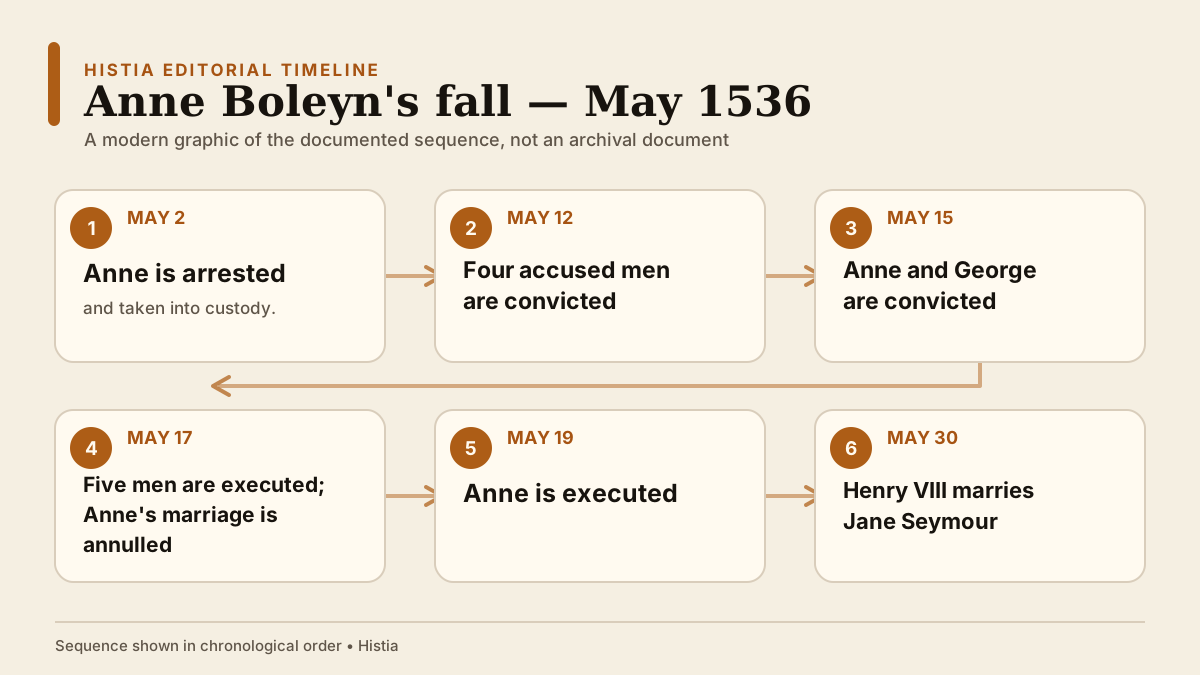
Timeline of Anne Boleyn's fall
- January 1536: Anne's pregnancy ended without a surviving son.
- May 2: Anne was arrested and taken to the Tower of London.
- May 12: four of the accused men were tried; all were convicted.
- May 15: Anne and George Boleyn were tried and convicted.
- May 17: George and the other convicted men were executed; Anne's marriage was annulled.
- May 19: Anne was beheaded inside the Tower.
- May 30: Henry VIII married Jane Seymour.
Frequently asked questions
What was Anne Boleyn officially executed for?
High treason, after allegations involving adultery, incest, and imagining the king's death.
Was Anne Boleyn guilty?
The record proves accusation and conviction, not factual guilt. Many historians doubt or reject the case; a minority scholarly interpretation has argued that some adultery allegations might have had a basis. The evidence does not justify presenting either position as directly witnessed fact.
Was Anne Boleyn executed for witchcraft?
Witchcraft is common in popular retellings, but the surviving trial record centers on treason, adultery, incest, and the king's death. It should not be listed as the formal conviction without a precise supporting record.
What was Anne Boleyn accused of?
Adultery with four men (Henry Norris, Francis Weston, William Brereton and the musician Mark Smeaton), incest with her brother George, and plotting or imagining the king's death. Because those acts touched the king and the succession, they were prosecuted as high treason. Anne denied every charge.
Why was Anne Boleyn's brother George executed?
George Boleyn, Lord Rochford, was tried by the same court of peers on May 15, 1536, charged with incest with Anne and with treason. He was convicted and beheaded on Tower Hill on May 17, two days before his sister, alongside Norris, Weston, Brereton and Smeaton. As with Anne, the record proves the charge and the verdict, not that the incest took place.
Was Anne Boleyn tortured?
No surviving record says Anne was tortured. At trial, only the musician Mark Smeaton pleaded guilty; some contemporaries alleged that his confession had been obtained through torture or threats, which remains unproven. Anne and the other accused men denied the charges.
How was Anne Boleyn executed?
She was beheaded with a sword, not an axe, inside the Tower of London on May 19, 1536. Her sentence allowed burning or beheading at the king's pleasure; Henry chose beheading, and an expert swordsman was brought from Calais. She was buried in the Chapel of St Peter ad Vincula inside the Tower.
Why did Henry VIII have Anne Boleyn executed?
Formally, because she was convicted of high treason. Historically, the case unfolded after Anne failed to give Henry a surviving son, while he was courting Jane Seymour and Thomas Cromwell was building the prosecution. Historians still debate whether Henry believed the accusations or simply wanted Anne removed.
Sources
- The National Archives — Anne Boleyn's trial and its full explanatory transcript.
- The National Archives — King's Bench records education pack.
- Historic Royal Palaces — Anne Boleyn at the Tower of London.
- Historic Royal Palaces — Henry VIII, for the Jane Seymour sequence.
- Letters and Papers, Henry VIII, May 11–15, 1536, and May 16–20, calendared primary state papers.
- Greg Walker, “Rethinking the Fall of Anne Boleyn,” The Historical Journal, for the scholarly debate.
- Eric Ives, The Life and Death of Anne Boleyn (Blackwell, 2004), and G. W. Bernard, Anne Boleyn: Fatal Attractions (Yale University Press, 2010), present competing interpretations.
Checked August 10, 2026; questions added September 23, 2026. Where sources disagree, the disagreement is stated rather than resolved by invention.
Spotted an error? Tell us — factual corrections are recorded publicly.
Rather listen?
Make history a five-minute habit.
Histia turns moments like this into short narrated stories, free for iPhone and iPad.
- Listen, read, or watch in cinematic mode
- Quick quizzes to make it stick
- A map of history from 3000 BCE to 2025

Free to download · Optional in-app purchases · iOS 18+