Hundred Years' War · 25 October 1415
What Happened at the Battle of Agincourt?
On 25 October 1415, near the village of Azincourt in northern France, a small and sick English army under King Henry V destroyed a much larger French force in a single morning. The English were not looking for a fight. They were trying to get home to Calais after a costly siege, and the French had blocked the road. What decided the day was the ground: a narrow, freshly ploughed field soaked by a night of rain, which turned the French attack into a slow crawl through mud under English longbow fire. Several thousand Frenchmen died, many of them nobles. The victory made Henry the most powerful man in Western Europe for a few years, but it did not win England the war.
Agincourt is one of those battles everyone has heard of and almost nobody can explain. Most of us know it through Shakespeare: the king walking among his men in the dark, the “band of brothers” speech, the happy few. The real story is stranger, muddier and, in one moment, much darker than the play. It is also a good lesson in how a single morning can change everything and, at the same time, settle very little.
Documented record Why an English king was marching through France in the rain
Henry V was in his late twenties and had been king for two and a half years. He claimed the French crown, as his great-grandfather Edward III had done when the Hundred Years' War began in 1337, and France was in no state to argue: its king, Charles VI, suffered long bouts of mental illness, and the great noble families were close to civil war with one another.
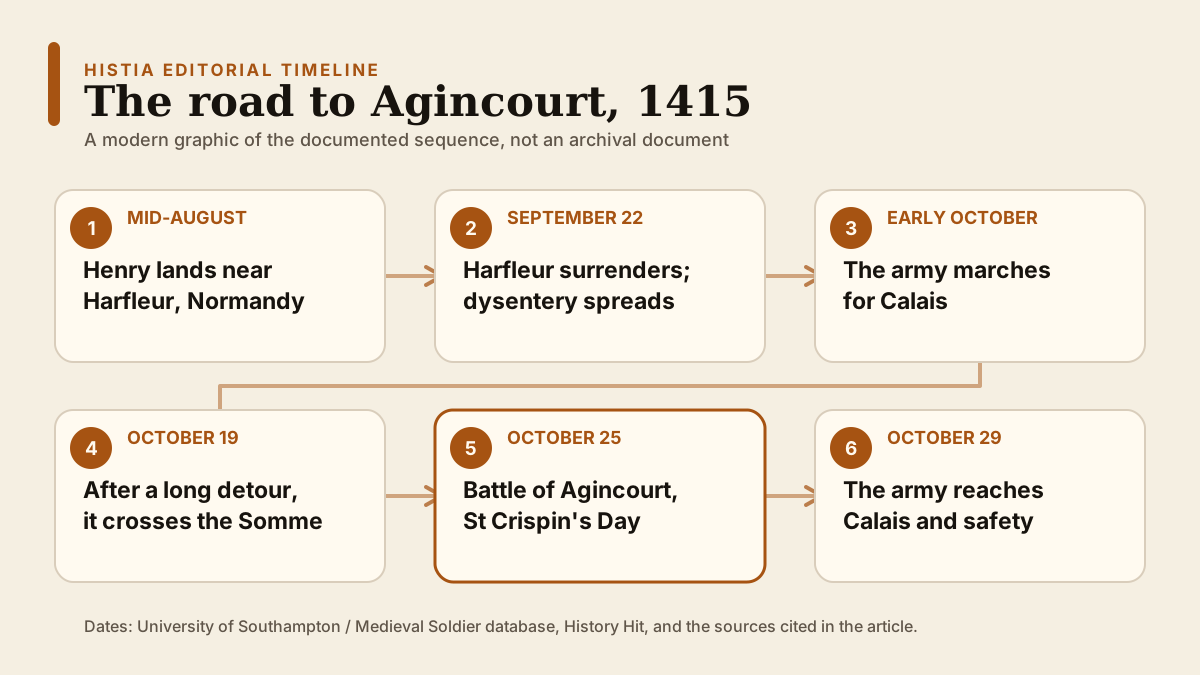
In August 1415 Henry landed in Normandy and besieged the port of Harfleur. He expected it to fall quickly. It held out for over a month and surrendered on 22 September, by which time dysentery was running through his camp. Thousands of men died or were sent home sick. Henry left a garrison in the town and, in early October, set off with what remained of his army for English-held Calais, about 120 miles up the coast.
It should have taken about a week. The French were waiting at the fords of the Somme, so the English had to march far inland to find a crossing, which they managed on 19 October. By then they had been on the road for two weeks, food was running out, and it kept raining. On 24 October they found the French army drawn up across their path near the castle of Azincourt.
Contemporary account The night before
Both armies spent the night in the open, a few hundred yards apart. According to the chaplain who travelled with Henry and wrote the Gesta Henrici Quinti shortly afterwards, the king ordered complete silence in the English camp, on pain of punishment. The French side was by most accounts noisy and confident. It rained heavily all night on a field that had recently been ploughed.
That rain matters more than any speech. Shakespeare's Henry walks through the camp in disguise and talks to his soldiers; there is no evidence that happened. What the sources do describe is an army that was hungry, wet, ill, and expecting to die.
Documented record The battle in four moves
1. Henry moves first. The field lay between two woods, those of Agincourt and Tramecourt, which narrowed the space toward the English end. For hours on the morning of the 25th neither side attacked. The French could afford to wait; the English could not. So Henry did something risky: he moved his whole army forward until the French were within longbow range, and his archers hammered sharpened wooden stakes into the ground in front of them, angled toward the enemy.
2. The cavalry charge fails. The French horsemen on the wings charged the archers. They had to cross wet, ploughed ground into a storm of arrows, and the woods kept them from going round the English flanks. Horses wounded by arrows or caught on the stakes turned and bolted back through their own side.
3. The mud. Behind them, the main French force of dismounted men-at-arms was already advancing on foot, in full plate armour, across the same churned field. Every step sank. As the field narrowed, the men at the front were pushed together by the ranks behind until, by several accounts, they had little room to raise their weapons. Men who fell could not get up; some were crushed or smothered under others.
4. The archers join in. When the French line reached the English men-at-arms, it was exhausted and packed tight. The English archers, lightly equipped and able to move on the mud, dropped their bows and went in with swords, axes and mallets. The fighting at the front became a slaughter.
Documented record The order to kill the prisoners
This is the part the play softens. With the battle apparently won, the English held a very large number of French prisoners, valuable for their ransoms. Then came news of an attack on the English baggage train, and the remaining French troops seemed to be preparing another assault. Henry ordered the prisoners killed. English and French chroniclers both record it, and many English soldiers were reluctant, partly because a dead prisoner paid no ransom.
How many died this way is unknown, and historians still argue about whether the order was a cold-blooded necessity, because the English were too few to guard their captives and fight again, or something worse. Most accept that it was not considered a crime by the standards of the time. It still sits uneasily next to the heroic version of the day.
Disputed interpretation How outnumbered was Henry really?
The legend says the English were outnumbered five or six to one. Medieval chroniclers put the French army at 50,000 or more, which no modern historian accepts. The most influential modern study, by Anne Curry at the University of Southampton, used English pay and muster records to estimate about 8,500 English and about 12,000 French, which would make the odds closer to three to two. Her point was partly practical: the field was too narrow to hold the numbers the chroniclers claimed.
Other historians think the French army was much bigger, perhaps twice that size or more, and the debate is not settled. What everyone agrees on is that the English army was mostly archers, roughly four or five for every man-at-arms, and that it was the weaker side that morning.
Documented record Who died, and who was taken
The French losses fell hardest on the people who usually survived medieval battles: great nobles worth ransoming. The dead included the commander, Constable Charles d'Albret, and the dukes of Alençon, Bar and Brabant. Charles, Duke of Orléans, the king's nephew, was taken prisoner and spent the next twenty-five years as a prisoner in England, where he wrote some of the finest French poetry of the century.
Common estimates put the French dead in the thousands, often around 6,000, though every figure is uncertain. English losses were small by comparison, in the hundreds at most, and English chroniclers claimed far fewer. The highest-ranking English dead were the king's cousin Edward, Duke of York, and the young Earl of Suffolk.
Did Agincourt change the war?
Yes and no. In the short term it was devastating for France: a generation of its military leaders was dead or in English hands. Henry returned to London to a hero's welcome in November 1415, came back to France in 1417, and conquered Normandy town by town. In 1420 the Treaty of Troyes made him heir to the French throne and husband of Charles VI's daughter, Catherine of Valois.
Then, in August 1422, Henry died of illness at the age of 35, weeks before Charles VI. His son was nine months old. Within a decade Joan of Arc had turned the war around, and by 1453 England held nothing in France except Calais. Agincourt won Henry a crown he never wore. That is the strange thing about it: it is the most famous English victory of the Middle Ages, and the side that lost it won the war.
Three myths about Agincourt
- The V sign. The story that English archers showed the French two fingers to prove they still had them has no source from the time. Anne Curry calls it a 20th-century urban myth.
- “We few, we happy few, we band of brothers.” Those words were written by Shakespeare in about 1599, nearly two centuries later. Henry probably did address his army, but nobody recorded a speech like that.
- A Welsh army. Welsh archers did fight at Agincourt, but Curry's records show around 500 of them, a small part of the army rather than its core.
Test yourself: three questions from the Histia quiz
Agincourt was fought during which war?
The Hundred Years' War. The quarrel was over Henry's claim that he, not the Valois king, was the rightful ruler of France.
Why was Henry's army exhausted, outnumbered and far from safety when it had to fight?
A long siege at Harfleur and a hard march toward Calais had worn it down, and a French army blocked the road. Henry was trying to reach safety, not looking for a battle.
Why did the terrain work so badly against the French?
A narrow, newly ploughed, rain-soaked field funnelled their armoured men into deep mud, with woods on both flanks stopping them from going round the English line.
Hear it, then see what stuck
Reading a battle is one thing; remembering it next week is another. In Histia, “Henry V at Agincourt” is a short narrated story you can listen to, read along with or watch in cinematic mode, and the eight-question quiz afterwards tells you what you actually kept. Free to download for iPhone and iPad (iOS 18+), with optional in-app purchases.
Play the Agincourt storyFrequently asked questions
When was the Battle of Agincourt?
Friday 25 October 1415, the feast of Saints Crispin and Crispinian, near the village of Azincourt in what is now the Pas-de-Calais department of northern France.
Who won the Battle of Agincourt?
The English army of Henry V won a crushing victory over a larger French army. Several thousand Frenchmen were killed or captured, including many of France's greatest nobles, while English losses were small by comparison.
Why did the English win at Agincourt?
Mostly because of where and how the French had to attack. A narrow, freshly ploughed field soaked by overnight rain funnelled heavily armoured French men-at-arms into deep mud, where massed English longbowmen behind sharpened stakes could shoot into them and then join the fighting once the French were exhausted and packed too tightly to use their weapons.
How many men fought at Agincourt?
Nobody knows exactly. Using English pay and muster records, the historian Anne Curry estimated about 8,500 English and about 12,000 French. Other historians argue the French army was much larger, and medieval chroniclers gave figures of 50,000 or more that modern scholars do not accept.
Did the V sign come from Agincourt archers?
There is no evidence for it. No source from the time mentions English archers taunting the French with two fingers, and Anne Curry describes the story as a 20th-century myth.
Where is Agincourt today?
The village is now spelled Azincourt and lies in the Pas-de-Calais, roughly 60 kilometres south of Calais. The battlefield is still open farmland, and the village has a museum and visitor centre about the battle.
Sources
- University of Southampton — “The truth about Agincourt”, on Anne Curry's army estimates, the Welsh contingent and the V-sign myth.
- The Medieval Soldier database — the Agincourt campaign, built from the English muster rolls in The National Archives, for the campaign dates and the sick lists from Harfleur.
- History Hit — How Henry V won at Agincourt, for the siege of Harfleur, the stakes and the killing of the prisoners.
- Wikipedia — Battle of Agincourt, for an overview of the chronicle sources and the casualty debate.
- Gesta Henrici Quinti, the account of the campaign by a chaplain in Henry's army, ed. and trans. F. Taylor and J. S. Roskell (Oxford, 1975).
- Anne Curry, The Battle of Agincourt: Sources and Interpretations (Boydell, 2000) and Agincourt: A New History (Tempus, 2005); Juliet Barker, Agincourt: The King, the Campaign, the Battle (Little, Brown, 2005), which argues for a larger French army.
Checked October 21, 2026. Where historians disagree, notably on army sizes and casualties, the disagreement is stated rather than resolved.
Spotted an error? Tell us — corrections are logged and the update date above is revised.
Rather listen?
Hear “Henry V at Agincourt” as a short story.
It is a narrated story in Histia, the free history app for iPhone and iPad, with a quiz at the end.
- Listen, read, or watch in cinematic mode
- An eight-question quiz to make it stick
- A map of history from 3000 BCE to 2025

Free to download · Optional in-app purchases · iOS 18+