French Revolution · 14 July 1789
What Happened at the Storming of the Bastille?
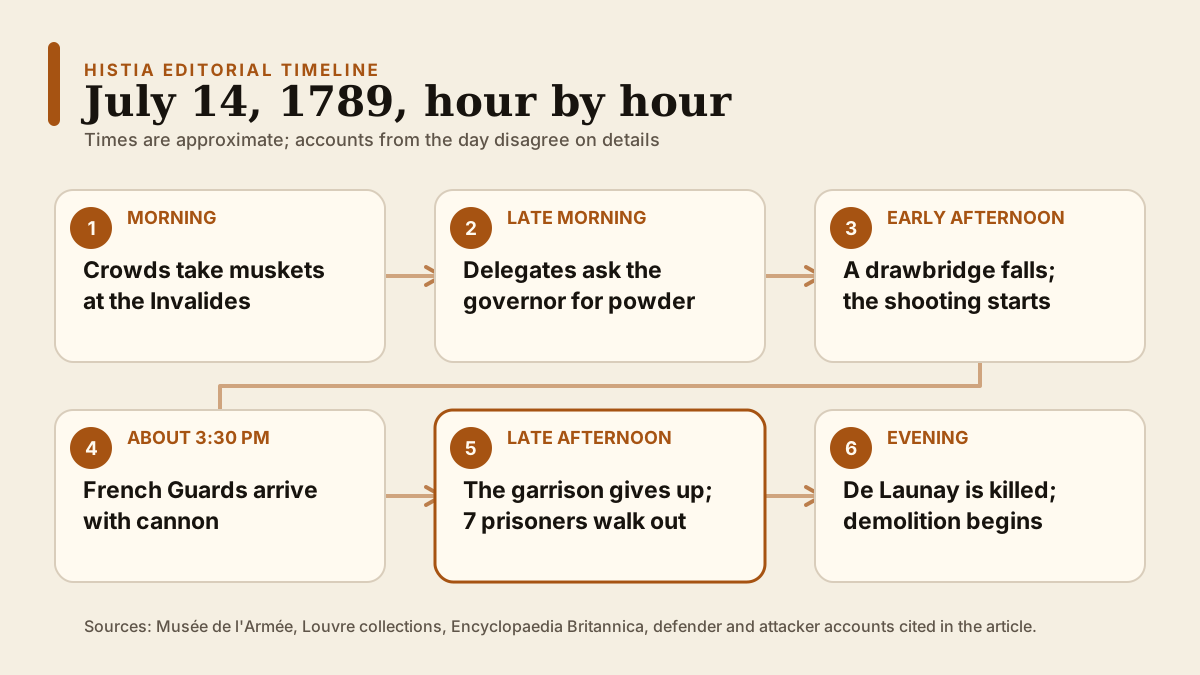
On 14 July 1789, an armed crowd in Paris attacked the Bastille, a medieval fortress used as a royal prison. They had come for gunpowder: that morning they had taken thousands of muskets from the Invalides, but had almost nothing to fire them with. After failed negotiations and several hours of shooting, soldiers of the French Guards joined the attackers with cannon, and the governor, Bernard-René de Launay, surrendered. The crowd freed the seven prisoners inside, killed de Launay, and began tearing the building down that same evening. It was not the start of the French Revolution, but it was the moment the revolution showed it could fight back.
The picture most of us carry is a mob breaking open a dungeon full of political prisoners. Almost none of that survives a look at the sources. The Bastille held seven men that day, none of them political. The crowd did not set out to free anyone. And the most important people in the attack were not revolutionaries at all, but professional soldiers who changed sides in the middle of the afternoon. What actually happened is less tidy and, honestly, more interesting.
Documented context Paris in July 1789: a city expecting an attack
By the summer of 1789 the revolution was already under way. The Estates-General had met at Versailles in May; in June the deputies of the Third Estate declared themselves a National Assembly and swore, in an indoor tennis court, not to disperse until France had a constitution. Louis XVI looked as if he had given way. At the same time, thousands of royal troops, many of them foreign regiments, were gathering around Paris and Versailles.
Then, on 11 July, the king dismissed Jacques Necker, the popular finance minister. The news reached Paris the next day. To many Parisians it looked like the first step of a crackdown on the Assembly. Bread was at its most expensive in years, crowds were burning the customs posts around the city, and in the gardens of the Palais-Royal a young journalist named Camille Desmoulins was telling people to arm themselves. Paris spent 13 July looking for weapons.
If you want the longer story of how France got here, we cover it in what caused the French Revolution.
Documented record They came for gunpowder
On the morning of the 14th, a huge crowd broke into the Hôtel des Invalides, the military hospital on the Left Bank, and carried off muskets and cannon. Muskets are useless without powder, though, and a large stock of it had just been moved for safekeeping to the Bastille, on the eastern edge of the city. That is why the crowd went there. Freeing prisoners was not the point.
The Bastille itself was a tall, eight-towered fortress from the 14th century, defended that day by 82 invalides, veteran soldiers no longer fit for field service, and 32 Swiss soldiers sent as reinforcements. The governor, de Launay, had little food and no water supply inside the walls. He was not a man anyone expected to hold out against a whole city.
Contemporary accounts The afternoon: talks, a falling drawbridge, and shooting
Several delegations from the city's new governing committee at the Hôtel de Ville went in to negotiate. De Launay received them, even invited one group to lunch, refused to hand over the powder, and pulled his cannon back from the embrasures as a gesture of goodwill. Outside, the crowd kept growing and had no idea what was being said.
In the early afternoon, a few men climbed onto the roof of a building next to the outer wall and cut the chains of a drawbridge. It crashed down, crushing a man underneath, and the crowd poured into the outer courtyard. Shots were fired, and the fighting began. Who fired first is still argued over: attackers later said the garrison lured them in and opened fire, while the Swiss officer Louis de Flue, who was inside, left an account that tells it quite differently. Both versions survive, and neither side had any reason to be neutral.
Documented record The turning point: soldiers change sides
For a few hours, the attack got nowhere. Civilians with muskets could not do much against thick stone walls. What changed things, at around 3:30 pm, was the arrival of companies of the French Guards, a royal regiment whose men had gone over to the people, led by two veterans, Pierre-Augustin Hulin and Jacob Élie. They brought cannon and aimed them at the main gate.
Inside, de Launay is said to have considered blowing up the powder magazine, which would have taken a good part of the neighbourhood with it. His own men talked him out of it. In the late afternoon the garrison lowered the inner drawbridge and the crowd surged in.
Documented record Seven prisoners
The cells held exactly seven people: four men accused of forgery, two who were mentally ill, and a count, the Comte de Solages, locked up at his own family's request. There were no political prisoners. The Bastille had held famous ones in the past, including Voltaire, and the idea of a place where the king could imprison anyone without a trial was exactly what made it hated. By 1789 the reality was a half-empty building the government had already talked about closing.
That did not matter. The crowd had taken the king's fortress, and the symbol was bigger than the building.
Documented record The violence afterwards
De Launay was marched toward the Hôtel de Ville through a furious crowd. On the way, or on arrival, he was killed, and his head was cut off and carried through the streets on a pike. Several defenders were also killed after the surrender. Encyclopaedia Britannica counts 98 attackers and one defender dead in the fighting itself; other counts differ, and you should treat any exact number with some caution.
This is the uncomfortable part of the story, and it was noticed at the time. The day that became the symbol of liberty also introduced Paris to heads on pikes, a sight that would come back, much worse, in the years that followed.
Disputed interpretation Did it start the French Revolution?
Not really, and historians are careful here. The revolution had begun at Versailles weeks earlier, with the National Assembly and the Tennis Court Oath. What 14 July did was show that the Assembly had an armed city behind it. Louis XVI pulled back his troops, recalled Necker, and on 17 July came to Paris and accepted the red, white and blue cockade of the new citizens' militia. Within weeks, peasant revolts were sweeping the countryside and the Assembly was abolishing feudal privileges. The Bastille did not start the fire, but it made it very hard to put out.
From fortress to national holiday
The building did not last long. A building contractor named Pierre-François Palloy started knocking it down on the evening of the 14th and turned the job into a business: he had stones carved into small models of the Bastille and sent them across France as souvenirs. In 1790 Lafayette sent one of the fortress's keys to George Washington as “a tribute, which I owe, as a son to my adoptive father.” It still hangs at Mount Vernon today.
Exactly one year after the storming, on 14 July 1790, hundreds of thousands of people gathered in Paris for the Festival of the Federation, a peaceful celebration of national unity with the king in attendance. When the Third Republic made 14 July the national holiday by a law of 6 July 1880, lawmakers deliberately left it open which of the two days they were honouring: the violent one or the peaceful one. In France, the holiday is simply le 14 Juillet. “Bastille Day” is what English speakers call it.
If you visit the Place de la Bastille today, look down rather than up. The outline of the old fortress is marked in the paving stones. The tall column in the middle of the square has nothing to do with 1789; it commemorates the revolution of July 1830.
Three things to remember
What was the crowd actually after?
Gunpowder. They had muskets from the Invalides but nothing to load them with, and the powder had just been moved to the Bastille.
What turned a stalemate into a victory?
The French Guards, royal soldiers who had joined the people, arrived around 3:30 pm with cannon and aimed them at the gate.
How many prisoners were freed?
Seven, and none of them was a political prisoner. The symbol mattered far more than the building.
Four minutes in Paris, 1789
An article gives you the facts; a story makes them stay. In Histia, the storming of the Bastille is a four-minute narrated story you can listen to on a walk, read along with, or watch in cinematic mode. It sits next to dozens of other turning points, from the pyramids to the fall of the Berlin Wall. Free to download for iPhone and iPad (iOS 18+), with optional in-app purchases.
Listen to the Bastille storyFrequently asked questions
Why was the Bastille stormed?
Mainly for gunpowder. Parisians had seized thousands of muskets at the Invalides on the morning of 14 July 1789 but had little powder, and a large stock had just been moved to the Bastille. Fear of royal troops gathered around Paris, anger at the dismissal of the finance minister Jacques Necker and the price of bread made the crowd determined to arm itself.
How many prisoners were in the Bastille when it was stormed?
Seven: four men held for forgery, two who were mentally ill, and a count imprisoned at his own family's request. None of them was a political prisoner.
How many people died at the storming of the Bastille?
Counts vary. Encyclopaedia Britannica gives 98 attackers and one defender killed in the fighting, with several more defenders, and the governor Bernard-René de Launay, killed after the surrender.
Is the Bastille still standing?
No. Demolition began the evening it fell and the fortress was gone within months. Its outline is marked in the paving around the Place de la Bastille, and some foundation stones survive. The column in the middle of the square commemorates the revolution of July 1830, not 1789.
Does Bastille Day celebrate the storming of the Bastille?
Partly. The French law of 6 July 1880 that made 14 July the national holiday deliberately left open whether it honoured 14 July 1789 or the peaceful Festival of the Federation held on 14 July 1790. In France the day is simply called le 14 Juillet or la Fête nationale; Bastille Day is an English name.
Sources
- Musée de l'Armée — the Bastille model and stone (PDF, in French), for the Invalides, the garrison, the negotiations, the seven prisoners and Palloy's demolition.
- Louvre collections — “Prise de la Bastille”, for the sequence of the day and de Launay's death.
- Encyclopaedia Britannica — Bastille, for the garrison, the French Guards, the powder magazine and the casualty count.
- Louis de Flue's account, by a Swiss officer inside the fortress, and an attacker's account, both in Liberty, Equality, Fraternity: Exploring the French Revolution (George Mason University).
- George Washington's Mount Vernon — Key to the Bastille.
- Library of Congress, In Custodia Legis — “Bastille Day Is About More Than the Bastille”, and the French National Assembly report on the 1880 law.
Checked October 21, 2026. Where the attackers' and defenders' accounts disagree, both are given rather than resolved.
Spotted an error? Tell us — corrections are logged and the update date above is revised.
Rather listen?
Hear the storming of the Bastille as a four-minute story.
It is a narrated story in Histia, the free history app for iPhone and iPad.
- Listen, read, or watch in cinematic mode
- Read along with the narration
- A map of history from 3000 BCE to 2025

Free to download · Optional in-app purchases · iOS 18+