
A practical starting point
How to learn ancient history without getting lost in the dates
Start learning ancient history with one region, a simple timeline, and a question about how people lived or held power. Compare Egypt, Greece, and Rome as overlapping societies, then widen the map. Pair short stories with museum objects and historical accounts so you can distinguish evidence from reconstruction.
Choose a manageable route into the ancient world
Ancient history covers far more than a list of emperors. It includes cities, farming, trade, religious practice, political power, and the experiences of people who rarely appear in famous biographies. Choose a question small enough to investigate: who commissioned a monument, what a coin says about a ruler, or how a city governed itself.
The route below begins around the Mediterranean because it offers an approachable connection between Egypt, Greek societies, and Rome. It is a starting selection, not a definition of world history. Mesopotamia, the Indus Valley, China, African societies beyond Egypt, and the ancient Americas deserve their own routes. Use our ancient civilizations timeline to keep that wider view.
Three starting points: Egypt, Greece, and Rome
| Starting point | Question to investigate | Your next action |
|---|---|---|
| Egypt | What can a monument tell us about power and work? | Study one object or building and identify its period. |
| Greek societies | How did communities represent citizens and political life? | Compare an object’s date, place, and purpose. |
| Rome | How did struggles over power change institutions? | Trace an event’s causes and consequences. |
Egypt: Start with the British Museum’s Egyptian sculpture gallery. Choose one object and record what its description says about its maker, period, and purpose. Do not assume every Egyptian object belongs to the same age. Then read how the pyramids were built to see how evidence and competing explanations enter a historical answer.
Greece: The Met’s essay on Classical Greek art connects objects with the political and cultural setting of the fifth and fourth centuries BCE. Choose one object from the essay, then ask what it tells you about its specific setting rather than treating it as a picture of every Greek community.
Rome: Use the assassination of Julius Caesar as a bounded political question. Identify the conspirators’ stated concerns, what they did, and what followed. Keep an individual’s motives separate from the long-term outcome. Those are different historical problems.
Build a timeline that shows overlap
Draw one line for each region in your notes. Add only the dates needed for your chosen objects and events. This stops a common mistake: treating Egypt, Greece, and Rome as three neat chapters that never overlap.
BCE dates count down toward the start of the common era: 500 BCE comes before 100 BCE. CE dates count upward. Labels such as “Classical” describe particular regional conventions, so write the approximate dates as well as the period name.
Do not turn a map pin into a claim about a country’s borders. A marker can show an event’s location without reconstructing the full political geography of its time. Our interactive history map guide explains how to use location and time as prompts for further research.
Explore ancient history with Histia
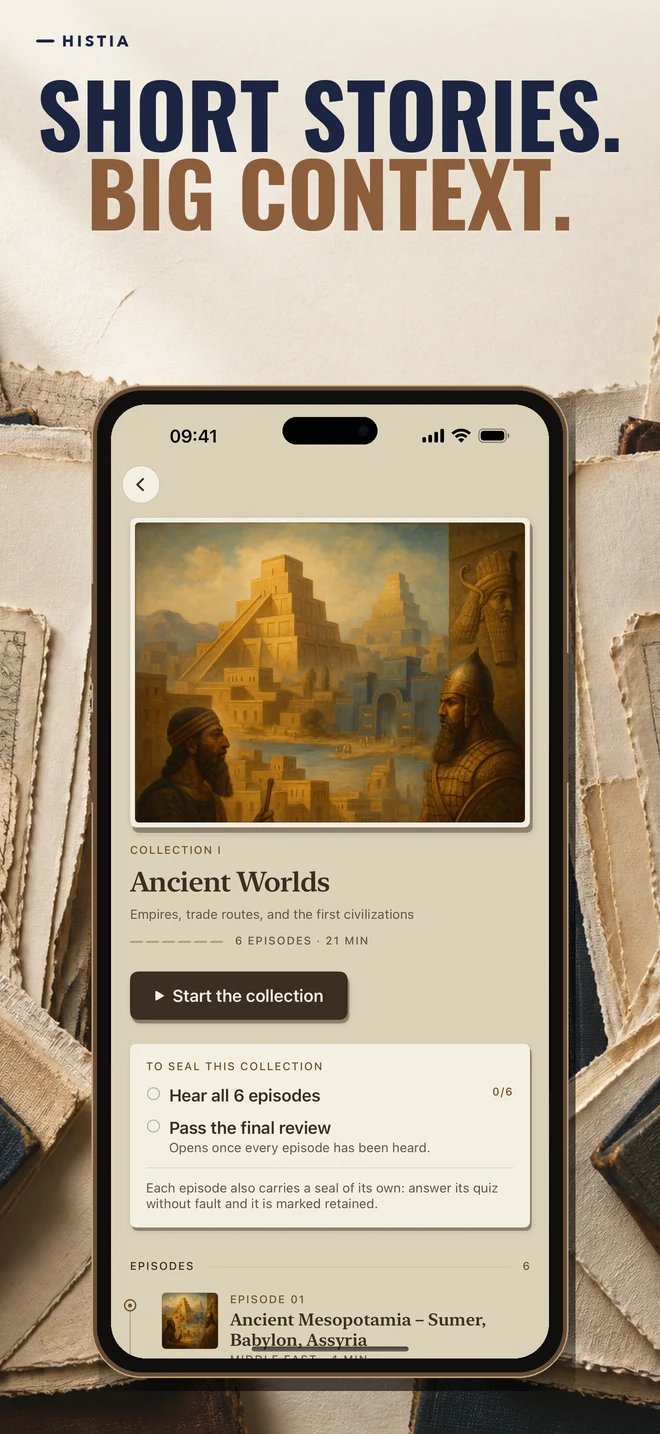
- Open a relevant themed series. Histia’s App Store screenshots show Ancient Worlds. Browse its available stories and choose a subject that matches your starting question.
- Use one episode as your introduction. Read or listen, noting the setting and the main change. Narrated cinematic visuals can introduce the story; they are not surviving evidence from antiquity.
- Find a connection in time and place. Explore available map markers or another story in the theme. Some markers show stories that have not yet been published.
- Check one detail outside the app. Use an object record, museum essay, or a source-linked article from the reading route above.
- Explain it without the screen. Try an available quiz or write your own one-sentence answer. Revisit the story if your timeline or explanation has a gap.
This route is an editorial suggestion, not a promise that every civilization, museum object, or event mentioned here has an episode in Histia. Browse the current catalog before choosing an access offer.
Follow your first question into Histia
Short narrated history stories for iPhone and iPad. Free to download, with optional in-app purchases.
Explore stories in HistiaAsk what survives from the ancient world
A useful study note separates three things: the surviving object or text, what a modern researcher concludes from it, and what remains unknown. A later account may preserve information about an earlier event, but its date and perspective still matter.
Try this exercise with one museum object: list two details explicitly supplied by the record, one interpretation you find in the accompanying essay, and one question the object cannot answer. Then compare your note with the confident version of the story you may have heard before.
That small distinction is a foundation you can keep using as the subject becomes more complex. For a broader routine, continue with the beginner’s history learning plan.
Common questions
What is the best way to start learning ancient history?
Choose one region and a focused question. Combine an overview with a timeline and one museum object or historical source. Expand into related regions after you can explain the first topic in your own words.
Should I learn Greek or Roman history first?
Either can be a starting point. Greek history offers routes into city-states, art, and political thought; Roman history offers routes into republican government, empire, and law. Follow your initial interest and keep track of the overlaps.
Does Histia cover every ancient civilization?
No complete coverage is promised. Histia’s current promotional materials show an Ancient Worlds series, but story and map availability vary. Use the current catalog alongside wider museum and reference resources.
Start with a story that interests you
Get Histia for iPhone and iPad, then choose your first available story.
Download HistiaFree to download · Optional in-app purchases · iOS 18+