
A practical starting point
How to learn history for beginners: start with one question
To start learning history, choose one question, read a short overview, and place the answer on a simple timeline. Follow one connected topic before moving to another era. A story app can make the first session approachable; museum collections and historical sources help you check and deepen what you learn.
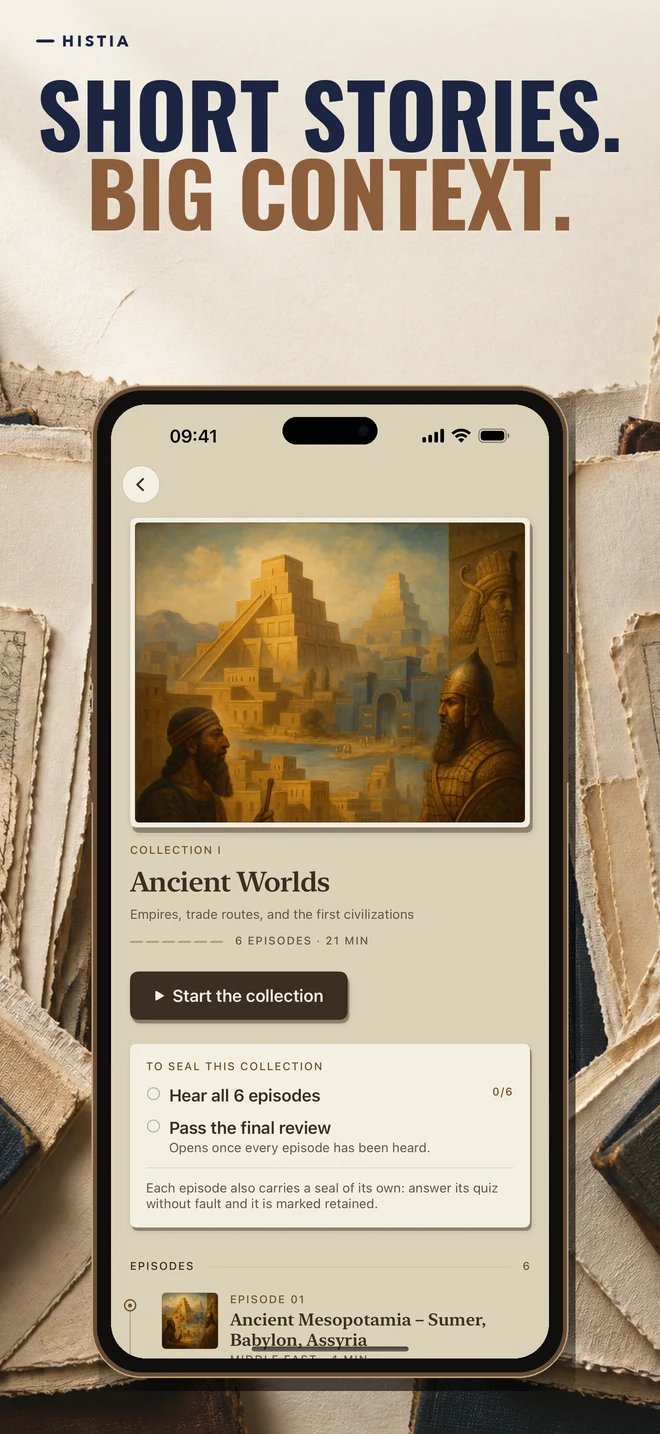
Where should a beginner start learning history?
Start where you already have a question. A film, a family story, a museum visit, or a place you know can supply it. “Why did this empire fall?” gives your first session a direction. “Learn all of world history” does not tell you what to do this afternoon.
Choose one region and one period for the first week. You do not have to begin with the earliest humans or read a textbook from its first page. Starting in the middle is workable if you keep asking what came before and what happened next.
Use a simple note with four headings: when, where, what happened, and why it mattered. Leave space for a fifth: “What is the evidence?” The American Historical Association describes historical study as a way to examine change and evaluate evidence; those are useful goals even for a beginner. Read the AHA’s explanation of why we study history.
A first-week history learning plan
This is a suggested route you can follow with free web resources, a book, or available Histia stories. It is not a built-in app course. Each session should leave you with one answer and one sensible next question.
| Session | What to do | What to keep |
|---|---|---|
| 1. Choose | Pick a person, place, or event. Read a short overview. | One question you want answered. |
| 2. Locate | Find its region and approximate period on a map and timeline. | A place and an anchor date. |
| 3. Go back | Investigate what happened before your event. | One condition that helps explain it. |
| 4. Follow through | Read what changed afterward. | One consequence, with a source. |
| 5. Check | Compare an account with a museum object, document, or scholarly explanation. | A supported fact and an open question. |
| 6. Recall | Explain the sequence without your notes, then check it. | A corrected three-sentence summary. |
| 7. Connect | Choose a related topic for next week. | A clear next step. |
If your time is limited, spread a session over several days. A sustainable starting point matters more than finishing this plan on a deadline. For a tighter routine, use our five-minute history learning guide.
A worked example: start with Cleopatra
Begin with “What can we know about Cleopatra’s death?” Our source-linked Cleopatra guide distinguishes later historical accounts from what those accounts can establish. Your first note should preserve that distinction rather than turning a dramatic detail into a certainty.
Next, locate Egypt and Rome and place the story in the late first century BCE. Then ask why Roman politics mattered to an Egyptian ruler. Move to the assassination of Julius Caesar for related context, keeping the two events separate in your notes.
Finish with three sentences: one about the setting, one about the sequence, and one about a source’s limits. This exercise is more useful than collecting five disconnected quotations about Cleopatra. It gives your next reading a purpose.
How to use Histia as a beginner
- Choose a story, not a completion target. Download Histia for iPhone or iPad and browse an available story or themed series that matches your question.
- Check the duration and access. Story lengths vary and optional purchases may apply. Pick a session that fits the time you actually have.
- Listen or read along. Follow narrated cinematic playback, or use the text to slow down around names and dates. Pause when you need to add a note.
- Make one connection. Browse a related story or inspect an available marker on the map. Some map stories are still to come.
- Recall and verify. Try a quiz where available, or use your own questions. Follow a museum or historical source when you want to check a detail.
Histia provides a short-story format for getting started. Your notes, timeline, and source checks are learning activities you do alongside it; this guide does not imply an in-app notebook or a complete beginner syllabus.
Follow your first question into Histia
Short narrated history stories for iPhone and iPad. Free to download, with optional in-app purchases.
Explore stories in HistiaThree beginner mistakes to avoid
Memorizing a date without an event. Give each date a place and an action. It is easier to see why an anchor date belongs in your notes when you can explain what it marks.
Confusing a vivid scene with evidence. A cinematic reconstruction can help introduce a subject. A surviving document or object answers a different question: what evidence do we actually have? Keep both roles clear.
Trying to cover every civilization in order. A single timeline can suggest that one society simply replaced another. Many societies overlapped. Compare regions when you are ready to expand beyond your starting topic.
Common questions
Can I learn history on my own?
Yes. Start with accessible overviews, keep track of dates and places, and compare sources as your questions become more specific. A short-story app can support the routine; deeper study needs sustained reading and evidence checking.
Should I learn history in chronological order?
Chronology helps you understand sequences, but you can begin with a period that interests you. Build a small timeline around that topic and expand backward, forward, and into other regions.
Is Histia a free history course?
Histia is free to download with optional in-app purchases. It offers short history stories and supporting features, rather than a complete course with a fixed syllabus or a qualification.
Start with a story that interests you
Get Histia for iPhone and iPad, then choose your first available story.
Download HistiaFree to download · Optional in-app purchases · iOS 18+